
Google Maps Rankings Lynchburg VA: Five Moves That Make a Real Difference
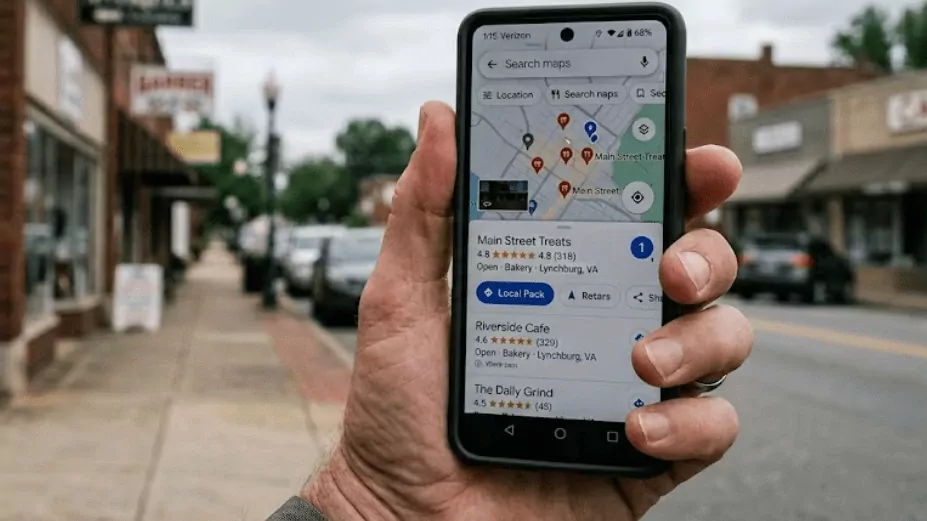
Understanding Google Maps Rankings Lynchburg VA Businesses Actually Compete For
Driving home along Boonsboro Road one evening last winter, I pulled up "electrician near me" on my phone at a stoplight. The three businesses in the local pack weren't the three I would have guessed were best in Lynchburg. Two of them I'd never heard of. The third I knew had struggled with their profile for years — and yet there they were. I checked their Google Business Profile. Clean categories, 34 recent reviews, a description with actual service language, photos uploaded within the last two weeks. Not magic. Just consistency.
Google Maps rankings Lynchburg VA businesses compete for are determined by three factors Google calls relevance, distance, and prominence. Relevance is how well your business profile matches what someone is searching for. Distance is how close your business is to the searcher's location. Prominence is how well-known and trusted Google considers your business to be, based on reviews, links, website signals, and overall online presence. Of these three, distance is the only one you can't directly influence. Relevance and prominence are both within reach.
BrightLocal's guide to ranking in Google Maps describes the four primary focus areas for maximizing local pack visibility: business data accuracy, local landing page quality, off-page visibility, and online reputation. A business that works all four simultaneously builds the kind of compounding signal that holds in rankings over time — not just earns a temporary bump.
The five moves below are the ones that consistently produce visible ranking movement for Lynchburg-area businesses — not theoretical factors, but actions with documented outcomes.
Move One: Category Precision and the Profile Signals That Establish Relevance
The most common mistake I see when auditing a Lynchburg business's Google Maps listing isn't a missing photo or an outdated phone number. It's a primary category that's one level too broad. "Contractor" when "General Contractor" is available. "Auto Repair" when "Auto Mechanic" is the better fit. "Restaurant" when "Pizza Restaurant" is what customers are actually searching for near the River Ridge Mall area.
Category selection is the highest-leverage decision on any Google Business Profile — consistently ranked as the single most important local pack ranking factor in local search ranking studies. The primary category tells Google's algorithm what search queries your business is eligible to appear for. Too broad, and you're competing against every service provider in a vague category. Too narrow or inaccurate, and you're missing searches that should be yours.
After setting the right primary category, add secondary categories that match real services you offer. An HVAC company might add Air Conditioning Contractor, Furnace Repair Service, and Heating Contractor as secondaries. Each additional relevant category expands the keyword footprint of the profile.
The business description is the second major relevance signal on the profile. Write it as if Google will read it — because it does. Include the specific services you offer and the specific communities you serve. "We provide residential and commercial roofing services throughout Lynchburg, Forest, Madison Heights, and Campbell County" is useful context. A tagline is not.
Getting category and description right establishes a relevance ceiling — but it's not enough on its own to push you into the top three results for competitive search terms in Lynchburg. What does the rest of the work is a combination of your website's local signals and your reputation score.
Move Two: Website Local Signals That Reinforce Your Map Listing
Twice in the past year I've watched Lynchburg businesses improve their Google Maps ranking within a few weeks of a single website change: adding their full address to the site footer. One was a service area business that hadn't displayed their address publicly before. The other was a company whose old website had an outdated address in the footer. Both saw local organic and map pack movement after the correction.
Your website and your Google Business Profile are not independent. Google looks for consistency between them. When the name, address, and phone number on your website matches your GBP exactly — same format, same phone number, same address structure — it confirms that the two are connected to the same real business at the same real location.
| Website Signal | What It Tells Google | Priority |
|---|---|---|
| NAP in site footer | Business operates at this location | High |
| Service area pages | Business serves these specific communities | High for SABs |
| Local phone number format | Business has local presence, not call center | Moderate |
| Embedded Google Map | Confirms location data across both systems | Moderate |
| Schema markup (LocalBusiness) | Structured signal for location and category | Moderate–High |
Service area businesses need location-specific pages even more than storefront businesses do. A plumbing company based in Lynchburg that serves Madison Heights, Forest, and Amherst County should have separate pages for each of those communities — not because Google requires them, but because without them, the website offers no geographic signal beyond the business's registered address. Those pages can be simple: a few paragraphs about serving that community, the specific services available there, and any relevant local detail that makes the page authentic rather than templated.
The website and profile alignment is the foundation — but the factor that most directly separates listings at the top of Lynchburg's map pack from those just below is what the next move addresses.
Move Three, Four, and Five — Reputation, Recency, and Response Rate
A contractor I've worked with in the Rivermont area told me his review strategy for years was "hoping people would leave one." His average had stagnated at 3.8 stars with 11 reviews. We started a simple system — after every completed job, he texts the homeowner a direct link to his Google review page with a single line asking if they'd share their experience. Within 60 days he had 28 reviews. His average moved to 4.7 and his map pack position for "general contractor Lynchburg" went from outside the top five to the third position.
Move three is building review velocity. Not a campaign. A system. Ask every customer, every time, using a channel that's convenient for them — text is typically the most effective because of open rates. The specific language matters less than the consistency. A direct link eliminates friction. A verbal ask at the end of every job creates the habit.
Move four is responding to every review within 48 hours. Google indexes review responses. A response that naturally includes service-relevant language — "glad the furnace installation went smoothly for your Dearington home" — reinforces the profile's keyword associations. Beyond the algorithmic benefit, response rate signals to prospective customers that you're paying attention.
Move five is citation accuracy. Your business listed consistently across Google, Apple Maps, Bing Places, Yelp, and industry directories gives Google confidence that the location data on your profile is reliable. Inconsistencies — different phone numbers, different address formats, different business name variations — create ambiguity. Clean them up with a core set of accurate, consistent listings rather than chasing every directory.
Explore how these moves connect to a broader Google Maps SEO strategy for Lynchburg businesses — the full picture of dominating the local 3-pack involves these same fundamentals working together as a system rather than in isolation.
All five moves are things a business owner can start this week without a budget. What they require is consistency over two to three months. That timeline frustrates people — but it's also the reason most of your competitors haven't done it yet. If they had, the pack would look different than it does right now.
If you want a clear-eyed look at where your Lynchburg listing stands and which of these moves would produce the fastest movement in your specific situation, Think Local Agency does exactly that kind of analysis. Call 434-215-9139 or visit local SEO services — the audit usually surfaces two or three specific actions that would make a measurable difference within 90 days. Most of the time, the conversation itself is worth the hour.
And visit thinklocalagency.com to learn more about how we work with Lynchburg businesses specifically.
Frequently Asked Questions About Google Maps Rankings in Lynchburg VA
Why does my business not show up on Google Maps even though I have a listing?
The most common reasons are an inaccurate or too-broad primary category, low review count or no recent reviews, and a mismatch between your website and GBP information. Google also uses the searcher's location as a strong proximity signal — if most of your searches are coming from outside your primary service area, your listing may not surface for those queries regardless of other factors.
How does Google decide which three businesses appear in the Lynchburg map pack?
Google's local algorithm weighs three factors: relevance (how well your profile matches the search query), distance (how close your business is to the searcher), and prominence (how well-known and trusted Google considers your business based on reviews, website quality, links, and overall online presence). All three contribute simultaneously — no single factor overrides the others completely.
Does proximity to the searcher always determine Google Maps rankings?
Proximity is a significant factor but not the only one. A business with a very strong profile, high review count, and well-optimized website can outrank a closer competitor that has neglected its online presence. In Lynchburg specifically, the winding street layout and neighborhood geography create situations where proximity ranking can vary meaningfully across the city's hills.
How many Google reviews do I need to rank in Lynchburg's map pack?
There's no fixed threshold, but competitive service categories in Lynchburg typically see the businesses in the top three positions with anywhere from 20 to 100+ reviews, depending on the vertical. What matters more than raw count is review recency and whether reviews include service-specific language. A business with 30 reviews in the past 90 days typically outperforms one with 100 reviews where the last one arrived eight months ago.
Does my website affect my Google Maps ranking?
Yes, meaningfully. Google's algorithm for local results explicitly incorporates website organic ranking as a signal. A website with accurate NAP in the footer, local service language, and technically healthy structure reinforces the GBP and improves overall map pack performance. A website that contradicts or ignores the GBP hurts it.
What is a Google Maps citation and why does it matter?
A citation is any online mention of your business's name, address, and phone number — on directories, review sites, industry listings, or news sites. Consistent citations across major platforms confirm to Google that your business is real and located where you say it is. Inconsistent citations — different phone formats, outdated addresses — create ambiguity that can suppress rankings.
Can I rank in multiple Lynchburg neighborhoods with one Google Maps listing?
A single Google Business Profile will rank most strongly in searches made near your registered location. To extend visibility across multiple Lynchburg neighborhoods, service area pages on your website that mention specific communities — Boonsboro, Rivermont, Forest, Madison Heights — give Google the geographic context needed to surface your listing for broader area searches.

Jesse Griffiths, founder of Think Local Agency
Hey there — I’m Jesse. I’ve been helping small businesses grow their online presence for over 10 years, and I started Think Local Agency because I believe every business deserves honest, straightforward marketing that actually gets results. When we work together it’s just you and me — no account managers, no layers, no feeling like “just another client.” I still answer my own phone and reply to my own emails because your success matters to me personally.

Privacy & Policy
Last Updated: May 24, 2023
This Privacy Policy explains how Think Local Agency (hereafter “we”, “us”, “our”) collects, uses, shares, and protects your personal information when you use our website, thinklocalagency.com. Please read this policy carefully to understand our practices regarding your personal information and how we will treat it.
Information We Collect
When you visit our website, we may collect the following information:
- Personal Information: This may include your name, address, email address, phone number, and other personal information you voluntarily provide to us when you request a quote, schedule a service, or contact us.
- Non-Personal Information: We collect non-personal information such as your browser type, IP address, operating system, and the pages you visited on our site.
How We Use Your Information
We use the information we collect to:
- Provide, maintain, improve, and promote our services
- Communicate with you about your requests, orders, and questions
- Personalize your user experience on our website
- Analyze website usage for internal marketing and quality control purposes
Sharing Your Information
We do not sell or rent your personal information to third parties. We may share your information with service providers that assist us with our business operations, such as IT and customer service, under strict data protection requirements.
We may also disclose your personal information if required by law or in the event of a business transfer (e.g., sale, merger, or acquisition).
Cookies
Our website uses “cookies” to enhance your experience. Cookies are small files stored on your device that allow us to recognize you when you return to our site. You can choose to accept or decline cookies by modifying your browser settings.
Protecting Your Information
We implement a variety of security measures to maintain the safety of your personal information. These include encryption, secure server environments, and other current technologies. However, please note that no method of transmission over the internet is 100% secure.
Children’s Privacy
Our website is not intended for use by individuals under the age of 18. We do not knowingly collect personal information from children under 13. If we discover that a child under 13 has provided us with personal information, we will promptly delete it.
Changes to This Policy
We may periodically update this policy. If we make significant changes, we will notify you through our website or via email.
Contact Us
If you have any questions or concerns about our Privacy Policy, please contact us at 434-215-9139.
By using our site, you consent to our Privacy Policy. If you do not agree with any part of this Policy, please do not use our website.
Terms of Services
Terms Of Service
Last Updated: May 24, 2023
Welcome to Think Local Agency (hereinafter “we”, “us”, “our”). The following Terms of Service (the “Terms”) govern your access to and use of our website thinklocalagency.com (the “Website”) and any services provided (the “Services”).
By using our Website and Services, you agree to be bound by these Terms. If you do not agree to these Terms, please do not use our Website or Services.
1. Use of our Website
You are permitted to use our Website for your personal, non-commercial use, or legitimate business purposes, provided your activities are lawful and in accordance with these Terms. You are not permitted to use our Website for any illegal or harmful purpose, or in any manner that could interfere with the operation of our Website.
2. User Content
If you submit or upload any content on our Website, you agree not to upload any content that is offensive, defamatory, or illegal, or that infringes on the rights of others. We reserve the right to remove or modify any content that we believe violates these standards or any other provisions of these Terms.
3. Intellectual Property
All content and materials available on our Website are owned by us or our licensors, and are protected by copyright, trademark, and other intellectual property laws. You may not use, copy, modify, distribute, or create derivative works from any part of our Website without express consent from us.
4. Service Appointments and Cancellations
When you book a service appointment, you agree to provide truthful and accurate information. You also agree to promptly notify us of any changes to your appointment.
In case of cancellations, please inform us at least 24 hours before your scheduled appointment. We reserve the right to charge a cancellation fee for any no-shows or late cancellations.
5. Disclaimers and Limitations of Liability
Our Website and Services are provided “as is” without any guarantees or warranties, expressed or implied. We do not warrant that the operation of our Website will be uninterrupted, error-free, or completely secure.
To the maximum extent permitted by law, we will not be liable for any direct, indirect, punitive, or consequential damages that may result from the use or inability to use our Website or Services, even if we have been advised of the possibility of such damages.
6. Changes to these Terms
We may periodically update these Terms. Any changes will be posted on this page, and by continuing to use our Website, you agree to be bound by any modifications to these Terms.
7. Governing Law
These Terms are governed by the laws of Virginia, USA. Any dispute arising from these Terms shall be resolved exclusively in the courts of Lynchburg, Virginia.
8. Contact Us
If you have any questions or concerns about these Terms, please contact us at 434-215-9139.