
I Started Noticing Fake Google Reviews Everywhere — Here's How to Spot Them
Driving back from a quick errand near Wyndhurst last October, I got a text from a roofing contractor I know — "check my competitor's Google page." Their rating had climbed from 3.7 to 4.9 in under two weeks. Forty-two new five-star reviews, not one of them mentioning anything specific about the actual work. I clicked three reviewer profiles. Each account had been created that same month, had no photo, and had posted no other reviews anywhere on Google.
That was one of the easier examples to read. Most fake Google reviews aren't that obvious — and your potential customers are checking.
Fake Google Reviews: How to Spot Them in the Review Text Itself
The fastest way to start screening a business's credibility is to look at what the reviewers actually wrote. Fake reviews share language patterns that real customer feedback almost never produces — and once you know what to look for, the signals are hard to unsee.
To spot fake Google reviews, focus on three immediate signals in the text: language that is emotionally positive without any specific detail ("amazing service, highly recommend!"), multiple reviews using nearly identical phrasing or sentence rhythm across different accounts, and reviews that drop the business name into a sentence the way an advertisement would — not the way a person recalling their actual experience would. Real customers describe what happened. Paid reviewers describe a feeling they were assigned to convey.
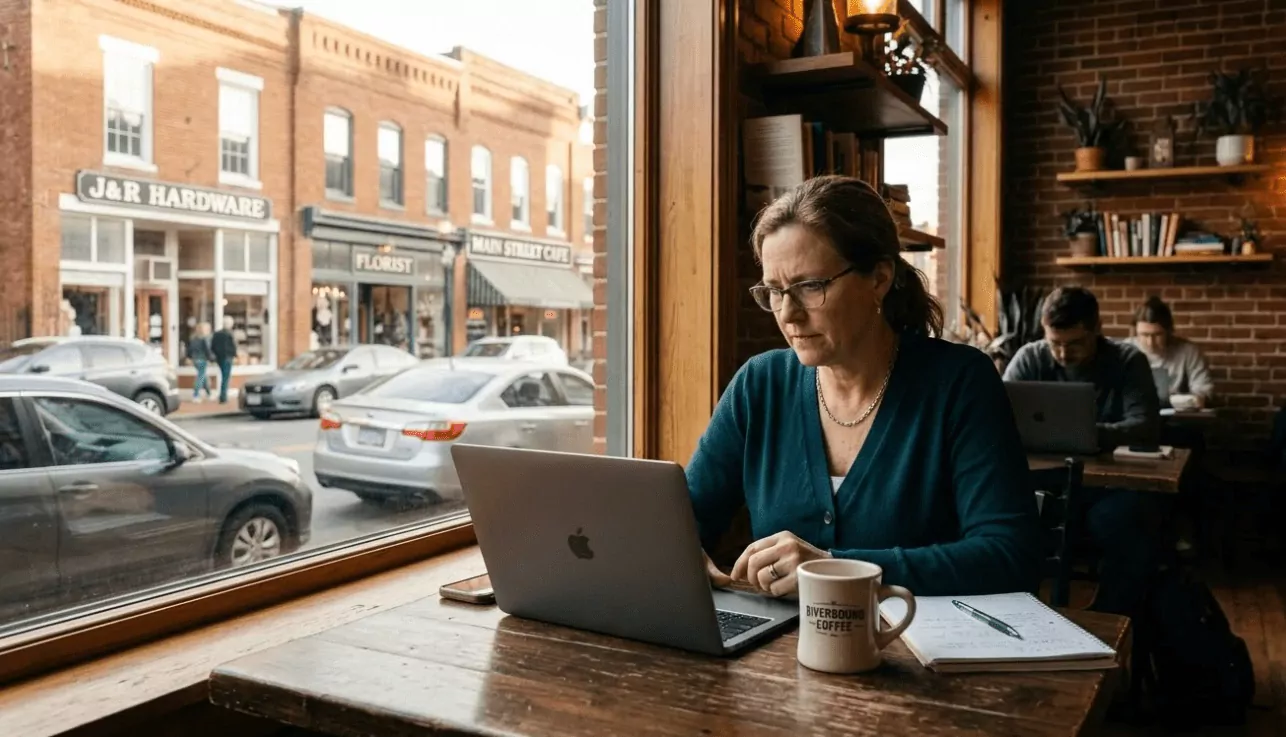
A few months back, I sat down at The Muse Coffee Co. on Main Street across from a woman vetting HVAC contractors before scheduling an estimate. She was reading reviews out loud and looking for something that felt real. One contractor's reviews were smooth and consistent — "professional team," "great communication," "highly recommend" — but nothing mentioned the actual job, the timeline, or any challenge the crew had to work through. "These sound like they were written by the same person," she said. She wasn't wrong to notice.
Specifics are the fingerprint of genuine experience. A real customer who had their furnace replaced in January doesn't write "wonderful experience." They write: "Showed up on time, finished before my kids got home from school, explained everything they replaced." The version with no detail is the version worth questioning.
Watch for one structural tell that shows up often: fake reviews frequently embed the business name into the sentence — "ABC Roofing exceeded every expectation." Real customers almost never do that. It's a pattern borrowed from review templates, and seeing it across three or four reviews on the same profile is a consistent signal of review manipulation at work.
The text is only half the picture, though. What the reviewer's profile reveals about who actually left the rating is usually harder to manufacture — and easier to verify than most people realize.
What a Reviewer's Profile Tells You Before You Read a Single Word
One morning I was checking a local pest control company on my phone while walking the Riverwalk Trail — doing homework before calling them about a problem at a rental property. A dozen reviews in, something caught my attention: several reviewers had "Local Guide" badges, which Google awards to frequent contributors. When I clicked their profiles, most had only two or three reviews total. A badge doesn't mean much when the account behind it has barely been used.
A genuine reviewer profile typically shows a history spread across several businesses — restaurants, service providers, shops — built over at least a year or two. Someone who has left twenty-five reviews across a dozen categories is almost certainly a real person. An account with one review, no profile photo, a generic name like "J Smith," and a creation date from last month deserves skepticism.
When you click a reviewer's name on Google, check four things: how many total reviews they've written, whether those reviews cover a geographic area consistent with a real local person, whether they've uploaded any photos alongside their reviews, and when the account was created. Fake accounts rarely invest in building out a convincing review history — it takes time and creates traceable evidence of the scheme.
The geographic check is one of the most practical signals for catching coordinated review fraud. A reviewer whose history spans Houston, Minneapolis, and Richmond — but who just posted a glowing review for a Lynchburg plumber — should give you pause. Real locals review local places. When the footprint doesn't match the location, the review may not either.
One important caveat: a sparse profile or missing photo doesn't automatically mean fake. Many real customers have barely-used Google accounts. What you're looking for is a pattern — several suspicious profiles concentrated among a business's most recent reviews. One thin account proves nothing. Eight of them appearing within the same two-week window is a different situation entirely.
Individual profiles tell you a lot — but what happens when you zoom out and look at the shape of the entire rating section is where the most useful signal tends to live.
The Rating Patterns That Signal a Bought Review Profile
I've looked at enough Google listings to say this with confidence: real businesses have uneven review profiles. Authentic ones have a few three-stars mixed in, occasional two-star reviews from a difficult job or a miscommunication, and months where no reviews came in at all. That unevenness is the signature of a real operation — where not every job goes perfectly and not every satisfied customer finds five minutes to leave feedback.
A profile with 200 reviews, a 4.9 average, and zero reviews below four stars across two-plus years is statistically unusual. It doesn't automatically mean the reviews were purchased, but it suggests either a filtering approach that steers unhappy customers away before they reach Google, a paid review scheme, or some combination. All three are worth knowing about before you hand over a deposit.
Review velocity is the clearest single pattern to watch. A business that gains fifteen reviews in a single weekend — with no announced event, no viral post, no identifiable driver — is a notable data point. Genuine burst activity from real customers tends to produce a mix of four and five-star reviews with varying lengths and detail levels. Paid campaigns typically produce a cluster of fives with similar structure and suspiciously little variation in language.
According to BrightLocal's guide on how to spot fake reviews, accounts created specifically to post fake reviews often have only one or two total ratings and may originate from locations entirely unrelated to the business being reviewed. Google reportedly blocked over 240 million fake or policy-violating reviews in 2024 — a figure that reflects both how widespread the problem is and how aggressively the platform's systems are now working to catch it.
| Pattern You Notice | What It Likely Signals | Trust Impact |
|---|---|---|
| 20+ reviews in a 3–7 day window with no announced event | Possible paid review campaign | High concern |
| Zero reviews below 4 stars across 100+ total reviews | Filtered, gated, or incentivized feedback | Moderate concern |
| Reviewer has only 1–2 reviews ever, recently created account | Likely throwaway fake account | Very high concern |
| Reviews mention employees by name and specific job details | Strong indicator of real customer experience | Positive signal |
| Multiple reviews share nearly identical phrasing or structure | Coordinated or AI-generated review scheme | Very high concern |
| Consistent review activity spread over 12+ months with mixed star ratings | Organic profile built over time | Strong positive signal |
Any serious local digital marketing strategy treats a perfect score as a liability, not a goal. The 4.6 with a few honest three-stars is almost always more persuasive to a skeptical consumer than a pristine 5.0 with zero variation — because the former looks like a real business and the latter looks like something that was engineered.
Understanding what a credible review profile actually looks like is central to any effective Google review strategy for small businesses — and it shapes how customers evaluate your trustworthiness before they ever make contact.
Most people who start checking these patterns run into the same question fairly quickly: not what the red flags mean, but what you can actually do once you've spotted them — and whether flagging a suspicious review to Google is worth the time.
Frequently Asked Questions
How can you tell if a Google review is fake?
Look at the reviewer's profile first — account age, total reviews posted, and geographic history. Then read the text itself for emotional language without any specific detail, scripted sentence structure, or phrasing that closely mirrors other reviews on the same profile. No single indicator is conclusive, but a cluster of new-account reviews appearing within a short window — especially combined with generic, template-style language — is a reliable signal that something is off.
Do fake Google reviews affect a business's ranking on Google?
They can, temporarily. Google uses review quantity and recency as local ranking signals, so a sudden surge of positive reviews may push a business higher in local search results. Google's detection systems have improved significantly and reportedly blocked over 240 million fake reviews in 2024, but some slip through before being caught. When fake reviews are eventually removed, the associated ranking benefit typically reverses as well.
How do you report a fake Google review?
Open the business profile on Google, find the review, and click the three-dot menu beside it. Select "Report review" and choose the most accurate reason, then save screenshots of what you submitted. If the initial report returns as "no policy violation," an appeal process is available through the "Manage Your Reviews" section of Google Business Profile — submitting screenshots that show matching language across multiple reviews considerably strengthens the appeal.
Does Google automatically detect and remove fake reviews?
Yes, Google uses automated systems that screen reviews before they're published, and the volume caught by those systems is substantial. But not every fake review gets flagged automatically, particularly when accounts are built over time to look genuine. When automation doesn't catch it, manual reporting and formal appeals through the Business Profile dashboard remain the path forward.
Should you trust a business that only has 5-star reviews?
A perfect score can actually be a reason to look more carefully rather than less. Every real service business encounters at least one difficult job or unsatisfied customer over time — a profile with zero lower-rated reviews across hundreds of transactions is statistically unusual. Combined with a sudden review surge, generic text patterns, and reviewer accounts with minimal history, it's a pattern worth pausing on before you commit.
What happens to businesses caught buying fake reviews?
Consequences have become more serious in recent years. As of 2024, buying or selling fake reviews became illegal for businesses that "knew or should have known" the feedback was false — a standard that now covers many paid review schemes. Consequences include FTC enforcement action, Google removing entire review profiles or flagging the listing in search results, and reduced local search visibility that can take months to recover.
Can a competitor leave fake negative reviews for my business?
Yes, and it happens more often than most business owners expect. The tactic — sometimes called negative review bombing — involves coordinated one-star reviews from accounts with no genuine connection to the business. If you suspect it, look for a cluster of negative reviews appearing in a tight window, check whether those accounts have any prior review activity elsewhere, and report them through your Google Business Profile dashboard with screenshots documenting the pattern.
What a Review Profile That Actually Earns Trust Looks Like
The surest protection against being mistaken for a fake-review business is building a profile that looks unmistakably real: some variation in star ratings, reviewers who describe actual work rather than vague satisfaction, and owner responses that sound like a human wrote them. That kind of profile doesn't come from a single push — it accumulates over months from customers who had a genuine experience and took a few minutes to say so.
I've watched businesses in this area spend money on paid review schemes, watch their ratings climb, and then lose most of those reviews in a Google sweep — sometimes along with legitimate ones caught in the same filter. The profile left behind is always harder to rebuild than if they'd put that same energy into earning genuine feedback from the start.
A student I spoke with at Virginia University of Lynchburg said she checks a review profile before she checks a business's website — and what earns her trust most is a listing that looks lived-in: mixed ratings, owner responses that address specific concerns, and consistent activity spread across at least a year. Building that through honest Google review generation over time is the only approach that holds up when skeptical customers start clicking.
If you're not sure whether your current review profile is sending the right signals to customers doing exactly this kind of research — or if you want help building a review presence that earns trust rather than just accumulates stars — the team at Think Local Agency works with Lynchburg businesses on that every day. Give us a call at 434-215-9139 and we'll take a look at what you're working with.

Jesse Griffiths, founder of Think Local Agency
Hey there — I’m Jesse. I’ve been helping small businesses grow their online presence for over 10 years, and I started Think Local Agency because I believe every business deserves honest, straightforward marketing that actually gets results. When we work together it’s just you and me — no account managers, no layers, no feeling like “just another client.” I still answer my own phone and reply to my own emails because your success matters to me personally.

Lynchburg, VA ~ 434-215-9139
Privacy & Policy
Last Updated: May 24, 2023
This Privacy Policy explains how Think Local Agency (hereafter “we”, “us”, “our”) collects, uses, shares, and protects your personal information when you use our website, thinklocalagency.com. Please read this policy carefully to understand our practices regarding your personal information and how we will treat it.
Information We Collect
When you visit our website, we may collect the following information:
- Personal Information: This may include your name, address, email address, phone number, and other personal information you voluntarily provide to us when you request a quote, schedule a service, or contact us.
- Non-Personal Information: We collect non-personal information such as your browser type, IP address, operating system, and the pages you visited on our site.
How We Use Your Information
We use the information we collect to:
- Provide, maintain, improve, and promote our services
- Communicate with you about your requests, orders, and questions
- Personalize your user experience on our website
- Analyze website usage for internal marketing and quality control purposes
Sharing Your Information
We do not sell or rent your personal information to third parties. We may share your information with service providers that assist us with our business operations, such as IT and customer service, under strict data protection requirements.
We may also disclose your personal information if required by law or in the event of a business transfer (e.g., sale, merger, or acquisition).
Cookies
Our website uses “cookies” to enhance your experience. Cookies are small files stored on your device that allow us to recognize you when you return to our site. You can choose to accept or decline cookies by modifying your browser settings.
Protecting Your Information
We implement a variety of security measures to maintain the safety of your personal information. These include encryption, secure server environments, and other current technologies. However, please note that no method of transmission over the internet is 100% secure.
Children’s Privacy
Our website is not intended for use by individuals under the age of 18. We do not knowingly collect personal information from children under 13. If we discover that a child under 13 has provided us with personal information, we will promptly delete it.
Changes to This Policy
We may periodically update this policy. If we make significant changes, we will notify you through our website or via email.
Contact Us
If you have any questions or concerns about our Privacy Policy, please contact us at 434-215-9139.
By using our site, you consent to our Privacy Policy. If you do not agree with any part of this Policy, please do not use our website.
Terms of Services
Terms Of Service
Last Updated: May 24, 2023
Welcome to Think Local Agency (hereinafter “we”, “us”, “our”). The following Terms of Service (the “Terms”) govern your access to and use of our website thinklocalagency.com (the “Website”) and any services provided (the “Services”).
By using our Website and Services, you agree to be bound by these Terms. If you do not agree to these Terms, please do not use our Website or Services.
1. Use of our Website
You are permitted to use our Website for your personal, non-commercial use, or legitimate business purposes, provided your activities are lawful and in accordance with these Terms. You are not permitted to use our Website for any illegal or harmful purpose, or in any manner that could interfere with the operation of our Website.
2. User Content
If you submit or upload any content on our Website, you agree not to upload any content that is offensive, defamatory, or illegal, or that infringes on the rights of others. We reserve the right to remove or modify any content that we believe violates these standards or any other provisions of these Terms.
3. Intellectual Property
All content and materials available on our Website are owned by us or our licensors, and are protected by copyright, trademark, and other intellectual property laws. You may not use, copy, modify, distribute, or create derivative works from any part of our Website without express consent from us.
4. Service Appointments and Cancellations
When you book a service appointment, you agree to provide truthful and accurate information. You also agree to promptly notify us of any changes to your appointment.
In case of cancellations, please inform us at least 24 hours before your scheduled appointment. We reserve the right to charge a cancellation fee for any no-shows or late cancellations.
5. Disclaimers and Limitations of Liability
Our Website and Services are provided “as is” without any guarantees or warranties, expressed or implied. We do not warrant that the operation of our Website will be uninterrupted, error-free, or completely secure.
To the maximum extent permitted by law, we will not be liable for any direct, indirect, punitive, or consequential damages that may result from the use or inability to use our Website or Services, even if we have been advised of the possibility of such damages.
6. Changes to these Terms
We may periodically update these Terms. Any changes will be posted on this page, and by continuing to use our Website, you agree to be bound by any modifications to these Terms.
7. Governing Law
These Terms are governed by the laws of Virginia, USA. Any dispute arising from these Terms shall be resolved exclusively in the courts of Lynchburg, Virginia.
8. Contact Us
If you have any questions or concerns about these Terms, please contact us at 434-215-9139.