
Review Generation and Local SEO Are More Connected Than You Think
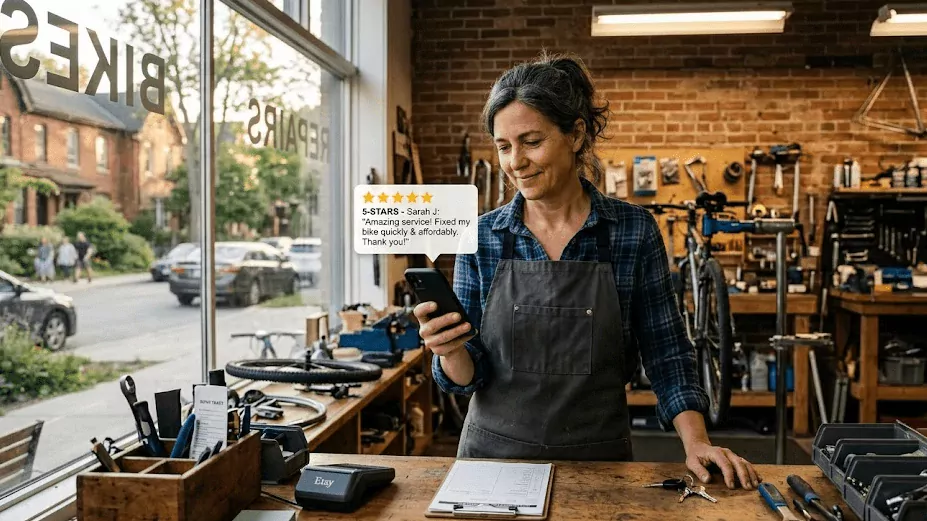
What Review Generation Actually Does to Your Local SEO Rankings
The afternoon I drove past Mission House Coffee on Cornerstone Drive and spotted a hand-lettered sign in the window — "Leave us a Google review, get 10% off your next visit" — I understood exactly where that owner was. Watching competitors pull ahead in local search results while doing everything else right. The missing variable was always review generation local SEO, and the connection is more mechanical than most people realize.
Review generation for local SEO refers to the deliberate, ongoing process of requesting and collecting customer reviews — particularly on Google — as a core component of a local search ranking strategy. It is distinct from passive reputation management. The difference is between hoping reviews accumulate and building a system that produces them consistently.
According to BrightLocal's 2026 Local Search Ranking Factors analysis, reviews have grown in importance for local pack rankings — rising from 16% of signal weight in 2023 to approximately 20% today. That shift didn't happen quietly. It reflects a deliberate change in how Google values trust signals from real customers versus technical optimization factors that can be manufactured.
For a business in Lynchburg competing for visibility in trades, home services, or professional services, that 20% represents the most controllable ranking lever available. Unlike domain authority or backlinks — which require months of content work and outreach — reviews can be influenced starting this week with a single workflow change.
The three things Google actually looks at in a review profile are quantity, recency, and content. A business with 60 reviews accumulated over three years will typically rank below a competitor with 40 reviews earned in the past six months. Recency matters because it signals that the business is actively operating and that customers continue to have positive experiences — both of which matter to an algorithm trying to show users relevant, current businesses.
What that means practically is that review generation isn't a one-time campaign. It's a permanent, low-friction system — and the businesses that treat it that way are the ones I've watched climb consistently in local results.
Understanding the ranking mechanics is the first piece. But the way reviews interact with click-through behavior and conversion once a listing actually appears in search results is where the compounding effect really shows up.
The Ranking Signals Hidden Inside Your Review Profile
I was auditing a local HVAC company's Google presence last spring — right around the time Langhorne Road construction was slowing everyone down and I was taking alternate routes through residential Timberlake. The company had good reviews overall, but two things stood out: nearly all of them were from more than 18 months ago, and none of the reviews mentioned specific services. Both are ranking signal problems.
Review content — specifically the keywords and service terms customers use in their review text — feeds directly into Google's relevance assessment for your listing. A customer who writes "they fixed our AC unit in less than two hours, incredibly fast service in Timberlake" is giving Google two signals at once: a geographic relevance signal and a service-category relevance signal. Neither of those signals appears in a one-sentence review that says "great company, highly recommend."
Do the keywords in Google reviews affect local search rankings? Yes, in a meaningful way. When customers naturally use terms related to your services in their review text, Google interprets those mentions as additional relevance signals for those service categories. This is not about coaching customers to stuff keywords — it's about prompting them to describe the actual work completed. "They replaced the water heater in our Garland Hill home within 24 hours" is a genuinely useful review that also happens to contain the location and service type.
Review velocity matters too. A sudden spike of 20 reviews in one week followed by silence for three months triggers skepticism in both Google's algorithm and potential customers reading the profile. A steady cadence — even two or three new reviews per month — signals an actively performing business more effectively than irregular bursts.
The star rating operates as a click-through multiplier in the local pack. Research from BrightLocal has shown that moving from a three-star to a five-star rating can produce roughly 25% more clicks from local pack results — meaning the ranking position is only half the battle. Two businesses at the same rank position but with different star ratings will produce different inquiry volumes.
Here's how the core review signals interact with local pack performance:
| Review Signal | What Google Measures | Effect on Ranking | Controllable? |
|---|---|---|---|
| Review volume | Total number of reviews | Prominence signal | Yes — ask more consistently |
| Review recency | How recently reviews were earned | Active business signal | Yes — ongoing cadence |
| Review content/keywords | Service and location terms in text | Relevance signal | Partially — prompt descriptive asks |
| Star rating | Average rating across all reviews | CTR and trust signal | Yes — earn and respond |
| Owner responses | Engagement rate and response speed | Engagement signal | Yes — respond to all reviews |
Most Lynchburg businesses focus exclusively on total review count and ignore the other four signals — which is why a competitor with 30 reviews that are recent, detailed, and responded to can outrank a business with 80 reviews that earned most of them three years ago and has never responded to one.
Knowing what signals matter is useful context. What determines whether any of this actually changes a business's search position is whether the ask process is consistent enough to produce a real cadence — and that comes down to a specific set of operational decisions that most businesses are still making incorrectly.
Building a Review Generation System That Runs Without Reminders
The electrician I talked to while waiting for parts at a supply house off Old Forest Road had 14 Google reviews. He'd been in business for nine years. When I asked him how he asked for reviews, he said, "I mention it if I remember." That's the most common review generation strategy in this market, and it's the most consistently ineffective one.
The goal is a system that triggers without a memory prompt. In practice, that means connecting the ask to a workflow moment that always happens — job completion, final invoice, or checkout — rather than to a variable decision. A text message sent immediately after the customer pays, with a direct link to the Google review page, converts at a significantly higher rate than a verbal ask at the door. The link removes friction. The timing, while the experience is fresh, captures genuine sentiment.
A follow-up matters too. Most businesses send one request and consider the task complete. A second message, sent five to seven days later for customers who didn't respond to the first, typically increases review acquisition by a meaningful margin without feeling pushy. The framing matters: "We'd still love to hear how everything went" is different in tone from a second reminder that reads like a campaign email.
Should you ask for Google reviews via text or email? Text consistently outperforms email for review requests in service-based businesses, particularly for trades and home services. The open rates are dramatically higher, and the mobile format removes the step of switching to a browser — the customer can tap the link and land directly on the review form. Email works well as a secondary channel or for businesses where the customer relationship is more formal, but for most Lynchburg contractors and service providers, text is the highest-performing channel.
You can see an expanded breakdown of how review generation services work for Lynchburg businesses — including specifics on timing, channel selection, and what the ask message should actually say.
What almost never gets discussed in the review generation conversation is what happens on the other side of the ask — the response strategy that either reinforces or quietly undermines everything the reviews are building.
Frequently Asked Questions About Review Generation and Local SEO
How many Google reviews does a business need to rank in the local pack?
There's no single threshold, and it varies by market competitiveness and category. In most Lynchburg service categories, a business with 30 or more recent, well-distributed reviews is competitive. What matters as much as the number is recency — 30 reviews earned in the past year typically outperforms 100 reviews from three years ago with no recent additions. Check the review profiles of the top three local pack results in your category to calibrate what competitive looks like in your specific niche.
Does responding to Google reviews help with local SEO?
Yes, and in two distinct ways. Google interprets owner responses as engagement signals — an indicator that the business is actively managing its presence and cares about customer feedback. For potential customers, response behavior is a trust signal that influences conversion. A business that responds thoughtfully to both positive and negative reviews demonstrates accountability, which is a factor that converts searchers who are comparing options before calling.
Can negative reviews hurt your local search rankings?
A small number of negative reviews is not typically a ranking penalty. In fact, a review profile with a few three-star or four-star reviews alongside mostly five-star reviews reads as more authentic to both Google's algorithm and human readers than a profile with 50 uniformly perfect reviews and no variation. What hurts rankings is a sustained pattern of low ratings combined with low total volume. The response to negative reviews also matters — a professional, non-defensive response demonstrates the kind of business behavior that retains customer trust even when a job goes wrong.
What's the difference between review generation and reputation management?
Review generation is the proactive process of asking customers to leave reviews as part of a consistent workflow. Reputation management is the broader practice of monitoring, responding to, and strategically managing your entire review presence across platforms. Both are valuable, but review generation is where most businesses need to start — because you cannot manage what you haven't first built. A business with 12 reviews has very little to manage; the priority is generation, not management.
Once a business reaches a critical review mass — typically 40 or more across its primary platforms — reputation management becomes more relevant as a retention and conversion tool.
Should businesses ask for reviews on platforms other than Google?
Google should be the primary focus for most Lynchburg businesses because Google reviews directly influence local pack rankings and map visibility. Secondary platforms — Yelp, Facebook, HomeAdvisor, and industry-specific directories — vary in relevance by business type. BrightLocal's 2026 Local Consumer Review Survey found that Apple Maps usage nearly doubled from 14% in 2025 to 27%, making it worth considering as a secondary platform for businesses serving mobile-first customers. The general rule is: dominate Google first, then expand to the platforms your specific customers actually use.
How do you ask for a Google review without violating Google's policies?
Google prohibits offering incentives in exchange for reviews — discounts, cash, gifts, or any other benefit tied to leaving a review. Asking directly, with a provided link and no conditional language, is fully compliant. The ask can be warm and personal without being incentive-based: "It would mean a lot to us if you'd share your experience on Google" is compliant. "Leave us a review and get 10% off your next visit" is not. Beyond policy compliance, incentivized reviews also tend to read as less authentic to potential customers reviewing the profile.
How often should a business be actively generating new reviews?
The answer is: always. Review generation should be treated as a permanent operational habit, not a periodic campaign. A business that runs a review push, gains 20 reviews, and then stops asking will find its profile aging in place while competitors with consistent cadences continue to accumulate freshness signals. Even one or two new reviews per month maintains the recency dynamic that helps keep a profile competitive. The simplest mental model is: every completed job is a review opportunity, and the ask is part of job closeout.
Making Review Generation Part of How Your Lynchburg Business Operates
There's a version of this that businesses overcomplicate. They research software platforms, compare review management tools, build multi-step automation sequences — and then delay implementation for six more weeks while the competitor down Timberlake Road keeps quietly accumulating reviews with a simple text message and a Google link.
The review generation process for local businesses comes down to three operational decisions: when in your workflow you ask, what channel you use, and whether you follow up once. Everything else is refinement. Start simple and make it consistent before you make it sophisticated.
What changes the trajectory for most businesses is treating review generation as a linked part of their local SEO strategy — not a separate activity. A business that sees each review request as also improving its Google rankings, its click-through rate, and its conversion from map searches starts to prioritize the ask differently. It stops being an awkward afterthought and becomes a business development habit.
The businesses in Lynchburg that have climbed the most in local search results over the past two years haven't done it with ad spend. They've done it with consistent, well-executed local marketing fundamentals — and review generation is the one most immediately actionable. If you want help building that system the right way for your specific business type and service area, Think Local Agency works with Lynchburg businesses on exactly this — reach out to the team at 434-215-9139 and see what a real conversation about your review strategy actually looks like.

Jesse Griffiths, founder of Think Local Agency
Hey there — I’m Jesse. I’ve been helping small businesses grow their online presence for over 10 years, and I started Think Local Agency because I believe every business deserves honest, straightforward marketing that actually gets results. When we work together it’s just you and me — no account managers, no layers, no feeling like “just another client.” I still answer my own phone and reply to my own emails because your success matters to me personally.

Privacy & Policy
Last Updated: May 24, 2023
This Privacy Policy explains how Think Local Agency (hereafter “we”, “us”, “our”) collects, uses, shares, and protects your personal information when you use our website, thinklocalagency.com. Please read this policy carefully to understand our practices regarding your personal information and how we will treat it.
Information We Collect
When you visit our website, we may collect the following information:
- Personal Information: This may include your name, address, email address, phone number, and other personal information you voluntarily provide to us when you request a quote, schedule a service, or contact us.
- Non-Personal Information: We collect non-personal information such as your browser type, IP address, operating system, and the pages you visited on our site.
How We Use Your Information
We use the information we collect to:
- Provide, maintain, improve, and promote our services
- Communicate with you about your requests, orders, and questions
- Personalize your user experience on our website
- Analyze website usage for internal marketing and quality control purposes
Sharing Your Information
We do not sell or rent your personal information to third parties. We may share your information with service providers that assist us with our business operations, such as IT and customer service, under strict data protection requirements.
We may also disclose your personal information if required by law or in the event of a business transfer (e.g., sale, merger, or acquisition).
Cookies
Our website uses “cookies” to enhance your experience. Cookies are small files stored on your device that allow us to recognize you when you return to our site. You can choose to accept or decline cookies by modifying your browser settings.
Protecting Your Information
We implement a variety of security measures to maintain the safety of your personal information. These include encryption, secure server environments, and other current technologies. However, please note that no method of transmission over the internet is 100% secure.
Children’s Privacy
Our website is not intended for use by individuals under the age of 18. We do not knowingly collect personal information from children under 13. If we discover that a child under 13 has provided us with personal information, we will promptly delete it.
Changes to This Policy
We may periodically update this policy. If we make significant changes, we will notify you through our website or via email.
Contact Us
If you have any questions or concerns about our Privacy Policy, please contact us at 434-215-9139.
By using our site, you consent to our Privacy Policy. If you do not agree with any part of this Policy, please do not use our website.
Terms of Services
Terms Of Service
Last Updated: May 24, 2023
Welcome to Think Local Agency (hereinafter “we”, “us”, “our”). The following Terms of Service (the “Terms”) govern your access to and use of our website thinklocalagency.com (the “Website”) and any services provided (the “Services”).
By using our Website and Services, you agree to be bound by these Terms. If you do not agree to these Terms, please do not use our Website or Services.
1. Use of our Website
You are permitted to use our Website for your personal, non-commercial use, or legitimate business purposes, provided your activities are lawful and in accordance with these Terms. You are not permitted to use our Website for any illegal or harmful purpose, or in any manner that could interfere with the operation of our Website.
2. User Content
If you submit or upload any content on our Website, you agree not to upload any content that is offensive, defamatory, or illegal, or that infringes on the rights of others. We reserve the right to remove or modify any content that we believe violates these standards or any other provisions of these Terms.
3. Intellectual Property
All content and materials available on our Website are owned by us or our licensors, and are protected by copyright, trademark, and other intellectual property laws. You may not use, copy, modify, distribute, or create derivative works from any part of our Website without express consent from us.
4. Service Appointments and Cancellations
When you book a service appointment, you agree to provide truthful and accurate information. You also agree to promptly notify us of any changes to your appointment.
In case of cancellations, please inform us at least 24 hours before your scheduled appointment. We reserve the right to charge a cancellation fee for any no-shows or late cancellations.
5. Disclaimers and Limitations of Liability
Our Website and Services are provided “as is” without any guarantees or warranties, expressed or implied. We do not warrant that the operation of our Website will be uninterrupted, error-free, or completely secure.
To the maximum extent permitted by law, we will not be liable for any direct, indirect, punitive, or consequential damages that may result from the use or inability to use our Website or Services, even if we have been advised of the possibility of such damages.
6. Changes to these Terms
We may periodically update these Terms. Any changes will be posted on this page, and by continuing to use our Website, you agree to be bound by any modifications to these Terms.
7. Governing Law
These Terms are governed by the laws of Virginia, USA. Any dispute arising from these Terms shall be resolved exclusively in the courts of Lynchburg, Virginia.
8. Contact Us
If you have any questions or concerns about these Terms, please contact us at 434-215-9139.