
Asking Customers for Google Reviews the Right Way — Lynchburg Edition
That Unanswered Text Is Costing You Stars
Sitting at a red light on Garland Hill one Tuesday afternoon, I felt that specific low-grade dread that every small business owner knows — the kind that arrives like a text you're not sure you want to open. It was a voicemail from a longtime customer, and for thirty seconds I had no idea whether it was a complaint, a compliment, or nothing at all. That anxiety is real, and it's exactly what keeps most Lynchburg business owners from ever asking for a Google review in the first place. They don't want to seem pushy. They don't want to get the words wrong. So they say nothing — and their competitors quietly rack up five stars while they stay stuck.
The question most business owners never answer is simple: what is the right way to ask? Knowing how to ask customers for Google reviews — without violating Google's policies, without sounding scripted, and without making a loyal customer feel awkward — is a learnable skill. And in 2026, with local search more competitive than ever in markets like Lynchburg, it may be the single highest-return habit you can build.
A quick walk past Rivermont Pizza on a Friday evening tells you everything. Regulars wait twenty minutes for a table. The food is good, but so is the reputation — and that reputation lives in their Google reviews as much as it lives in word of mouth. What Rivermont figured out, intentionally or not, is that the ask doesn't have to be awkward. It just has to be honest and well-timed.
This post breaks down exactly what works, what violates Google's terms, and how to build a review-asking habit that fits naturally into how you already run your business.
That unanswered question — how exactly do I ask? — ends here. But knowing when to ask is just as important as knowing how, and that timing question trips up more businesses than any other part of the process.
When to Ask: Timing Is the Whole Game
My first real conversation about review timing happened on a job site in the Graves Mill Road corridor, talking to an HVAC contractor while he packed up his van after a service call. He told me he'd been meaning to ask customers for reviews "for years" — and every time the job wrapped up, he got distracted by the next call on his list. That five-minute window right after a completed job, he admitted, was the single best moment he'd ever wasted.
The foundational rule: ask at peak satisfaction, not at peak convenience for you. Peak satisfaction is the moment just after the value has been delivered — after the drain is cleared, the pizza arrives hot, the quote comes in lower than expected, or the technician explains exactly what was wrong in plain English. That moment is brief and perishable.
Asking too early — before the work is done or the product is in the customer's hands — produces weak, vague reviews. Asking too late — days or weeks after the fact — means the emotional memory has faded and the review never gets written. The sweet spot is within 24 hours of the completed service, and in many cases, within minutes.
For in-person businesses, that means training your team to make the ask at checkout or handoff, not in a follow-up email three days later. For service businesses, a text message sent the same afternoon the job closes is almost always more effective than a formal email sequence.
Here is a practical breakdown of timing by business type:
| Business Type | Best Moment to Ask | Best Channel | Avoid |
|---|---|---|---|
| Home service (HVAC, plumbing, etc.) | Same day, job complete | Text message | Email 1+ week later |
| Restaurant / food service | At bill drop or order pickup | Receipt QR code or verbal ask | Pop-up during ordering |
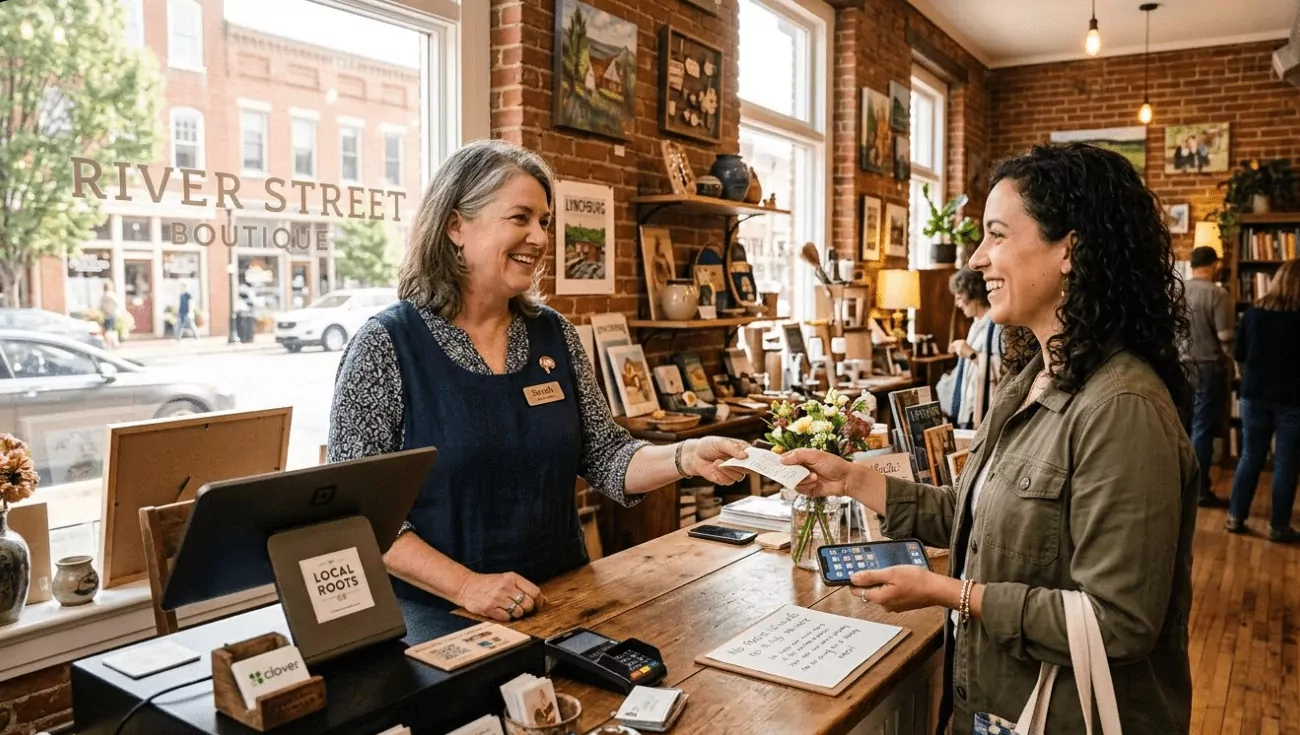
| Retail / boutique | At point of purchase | Verbal + printed card with link | Mass email blasts |
| Medical / healthcare | After discharge or follow-up call | Email or patient portal message | In-exam-room tablet prompts |
| Professional services (legal, financial) | After a successful outcome | Personal email or follow-up call | Generic review blast |
Centra Virginia Baptist Hospital — one of the largest employers in Lynchburg — has entire patient experience teams dedicated to the question of when and how to ask for feedback. That kind of disciplined attention to timing is not reserved for large institutions. Any business on any block in Lynchburg can apply the same logic with a single well-worded text.
Now that you know when to ask, the next piece most business owners skip entirely is what, exactly, to say — and the difference between a message that gets ignored and one that earns a five-star response is smaller than you'd think.
What to Say: Scripts That Feel Human, Not Robotic
During a workshop I ran for a group of Lynchburg contractors last spring, I asked everyone to read their current review request message out loud. Half the room winced before they finished the first sentence. The messages were technically correct — polite, grammatically fine — and completely lifeless. Nobody wants to write a review for a robot.
The most effective review requests share three traits: they are specific, they are short, and they give the customer a genuine reason to care. A message that says "We'd appreciate your feedback" is forgettable. A message that says "You were our first call this morning and it made our day — if you have 60 seconds, a Google review would mean the world to us" lands differently.
Specificity is the engine. Reference the actual job, the actual interaction, or the actual moment. That level of personalization signals that the request is real — not an automated blast — and it dramatically increases the chance that the customer clicks the link.
Here are three proven request formats for different channels:
Text message (for service businesses): "Hi [First Name] — glad we could get that [specific job] sorted out today. If you have a moment, a Google review helps our small team more than you know: [review link]. No pressure at all — thank you either way."
In-person verbal ask (for retail or restaurants): "If you enjoyed your experience today, we'd love a Google review — it takes about a minute and it really helps us out. Here's a card with the link if you want to bookmark it."
Follow-up email (for professional services): "Working with you on [project/outcome] was genuinely rewarding. If you're open to it, a quick Google review — even just a sentence or two — would help future clients find us. Here's the direct link: [link]."
What all three have in common is honesty. They don't overpromise. They don't beg. They acknowledge the customer's time and give them an easy exit. For a deeper breakdown of review request language that converts, the team at BrightLocal has documented exactly what language patterns drive higher response rates — worth a read before you finalize your own template.
Getting the words right is only half the challenge, though. The other half is the list of things businesses do that actively destroy their review efforts — and some of those mistakes are more common in Lynchburg than you'd expect.
What Never to Do: The Mistakes That Backfire in Real Markets
Walking through a corridor of long-established service businesses and newer shops on the way out toward Graves Mill Road, I've seen the same pattern repeat itself: a business with genuinely good service ends up with a warning flag on its Google listing because someone on the team thought they'd found a shortcut. There are no shortcuts. There are only policies — and Google enforces them.
The most damaging mistake is incentivizing reviews. Offering a discount, a free item, a gift card, or any reward in exchange for a Google review is a direct violation of Google's review policies. It doesn't matter how small the incentive is. If Google detects a pattern of incentivized reviews — and their systems are increasingly good at detecting exactly that in 2026 — the reviews get removed and the listing can be penalized.
The second major mistake is asking for reviews in bulk — sending a mass email or SMS blast to your entire customer list at once. Google's systems flag sudden spikes in review volume as suspicious. Even if every single review in that batch is authentic, they may be filtered out or the listing may be flagged for unusual activity. Steady, consistent volume over time is what Google rewards.
The third mistake — and the one that costs the most goodwill — is pressuring customers after they've already declined. One gentle follow-up, sent once, is acceptable. Sending three reminders in a week is the fastest way to turn a happy customer into someone who leaves no review, avoids your business, or worse, leaves a negative one about feeling harassed.
Here are the behaviors that most frequently trigger Google policy violations:
- Offering any reward, discount, or incentive in exchange for a review
- Asking only happy customers (review gating)
- Using kiosk devices in-store to collect reviews (violates Google's on-premises review policy)
- Buying reviews from third-party services
- Asking employees or family members to leave reviews
- Sending mass review request emails to cold or inactive lists
For a plain-language walkthrough of the compliance side, the step-by-step guide at Think Local Agency's Google review generation page covers exactly what Google permits and what it penalizes. And if you've already made some of these mistakes, knowing what not to do going forward matters more than worrying about the past.
Even a perfectly compliant, well-timed, warmly worded review request can still fail if your delivery system is broken — and most small businesses in Lynchburg have at least one weak link in the chain between the ask and the published review.
Building a System That Runs Without You Chasing It
The most useful conversation I've had about review systems happened in the parking lot outside Centra Virginia Baptist Hospital, talking to a physical therapist who had just started her own outpatient practice nearby. She had forty happy patients and zero Google reviews — not because her patients didn't care, but because she had no system. Every ask was manual, ad hoc, and easy to skip on a busy afternoon. Within ninety days of building a simple automated follow-up sequence, she had over thirty reviews and her Google Maps ranking had moved from page two into the top three results for her specialty in Lynchburg.
A review generation system doesn't have to be complicated. At its core, it needs three things: a direct review link, a reliable trigger, and a consistent follow-up sequence. The direct review link comes from your Google Business Profile — go to your profile, find the "Get more reviews" option, and copy the short link. That link eliminates the friction of customers having to search for your business to leave a review.
The trigger is the moment that kicks off the request — job completion, checkout, discharge, signed contract. The more clearly this trigger is defined in your team's workflow, the more consistently the ask happens. If the trigger is "when I remember," it will never be consistent.
The follow-up sequence is typically one initial request and one reminder, sent 3–5 days apart. After two touches, stop. Automation tools — whether built into your CRM, your point-of-sale software, or a dedicated review platform — can handle this sequence without requiring any manual effort after setup.
For more on how the right language pairs with an automated sequence, the overview at Think Local Agency covers how these systems fit into a broader local visibility strategy. Building the system is the part most business owners put off longest — but it takes about two hours to set up, and then it largely runs on its own.
Frequently Asked Questions
What is the best time to ask a customer for a Google review?
The best time to ask is within 24 hours of completing a service or transaction, while the customer's positive experience is still fresh. For in-person businesses, the moment of checkout or handoff is often the most effective window.
For service businesses, a same-day text message typically outperforms a follow-up email sent days later.
Can I send customers a direct link to leave a Google review?
Yes — and you should. A direct review link from your Google Business Profile removes the friction of customers having to search for your business manually. Go to your Google Business Profile dashboard, look for the "Get more reviews" or "Share review form" option, and copy the link.
Including this link in every review request is one of the simplest ways to improve your response rate.
Is it against Google's policies to offer a discount in exchange for a review?
Yes, offering any incentive — including discounts, free items, or gift cards — in exchange for a Google review is a direct violation of Google's review policies. Google can and does remove reviews it identifies as incentivized, and repeated violations can result in penalties to your Google Business Profile listing.
The only compliant approach is to ask sincerely, without conditions attached.
How many times should I follow up with a customer who hasn't left a review?
Send one initial request and one follow-up reminder, spaced 3–5 days apart. If a customer hasn't responded after two touches, let it go.
A consistent two-touch sequence across your full customer base will generate far more reviews than aggressive follow-up with a smaller group.
What should I say when asking for a Google review in person?
Keep it short, genuine, and low-pressure. Something like: "If you enjoyed your experience today, a quick Google review would really help us out — here's a card with the direct link." Mention that it only takes about a minute and that there's no pressure.
The key is to make the ask feel like a natural extension of the conversation, not a scripted transaction.
Does asking for reviews in a bulk email violate Google's guidelines?
Google's policies don't prohibit email requests, but they do flag sudden spikes in review volume as potential spam — which can cause authentic reviews to be filtered out. Sending a mass blast to your entire list at once creates exactly that kind of spike.
A staggered, consistent approach — sending review requests as part of your normal post-transaction follow-up — keeps your review velocity steady and avoids triggering Google's spam filters.
How do I get more Google reviews when my customers are older or less tech-savvy?
Printed cards with a QR code and a simple written URL work well for customers who aren't comfortable navigating to Google on their own. A verbal, personal ask — "I'll send you a quick text with a link that takes you right to it" — combined with a text message follow-up removes most of the confusion.
Walking a customer through the process the first time, even briefly, can turn one review into a habit they repeat for other businesses they love.
Ready to Stop Guessing and Start Growing Your Reviews?
Lynchburg is a relationship-driven market. Whether your customers are finding you for the first time on a Google search or walking through your door because a neighbor mentioned you, your reviews are doing the talking before you ever pick up the phone. The businesses that win local search in 2026 are not necessarily the ones with the most advertising budget — they're the ones with the most consistent, trust-building, policy-compliant approach to generating authentic reviews.
If you want a done-for-you system that handles review requests, follow-up, and reputation monitoring without you having to think about it, the team at Think Local Agency works specifically with local businesses in markets like Lynchburg — call them at 434-215-9139 and they can have a system running for you faster than you'd expect.
The ask that never happens is the review you never get. Start asking the right way, today.

Jesse Griffiths, founder of Think Local Agency
Hey there — I’m Jesse. I’ve been helping small businesses grow their online presence for over 10 years, and I started Think Local Agency because I believe every business deserves honest, straightforward marketing that actually gets results. When we work together it’s just you and me — no account managers, no layers, no feeling like “just another client.” I still answer my own phone and reply to my own emails because your success matters to me personally.

Lynchburg, VA ~ 434-215-9139
Privacy & Policy
Last Updated: May 24, 2023
This Privacy Policy explains how Think Local Agency (hereafter “we”, “us”, “our”) collects, uses, shares, and protects your personal information when you use our website, thinklocalagency.com. Please read this policy carefully to understand our practices regarding your personal information and how we will treat it.
Information We Collect
When you visit our website, we may collect the following information:
- Personal Information: This may include your name, address, email address, phone number, and other personal information you voluntarily provide to us when you request a quote, schedule a service, or contact us.
- Non-Personal Information: We collect non-personal information such as your browser type, IP address, operating system, and the pages you visited on our site.
How We Use Your Information
We use the information we collect to:
- Provide, maintain, improve, and promote our services
- Communicate with you about your requests, orders, and questions
- Personalize your user experience on our website
- Analyze website usage for internal marketing and quality control purposes
Sharing Your Information
We do not sell or rent your personal information to third parties. We may share your information with service providers that assist us with our business operations, such as IT and customer service, under strict data protection requirements.
We may also disclose your personal information if required by law or in the event of a business transfer (e.g., sale, merger, or acquisition).
Cookies
Our website uses “cookies” to enhance your experience. Cookies are small files stored on your device that allow us to recognize you when you return to our site. You can choose to accept or decline cookies by modifying your browser settings.
Protecting Your Information
We implement a variety of security measures to maintain the safety of your personal information. These include encryption, secure server environments, and other current technologies. However, please note that no method of transmission over the internet is 100% secure.
Children’s Privacy
Our website is not intended for use by individuals under the age of 18. We do not knowingly collect personal information from children under 13. If we discover that a child under 13 has provided us with personal information, we will promptly delete it.
Changes to This Policy
We may periodically update this policy. If we make significant changes, we will notify you through our website or via email.
Contact Us
If you have any questions or concerns about our Privacy Policy, please contact us at 434-215-9139.
By using our site, you consent to our Privacy Policy. If you do not agree with any part of this Policy, please do not use our website.
Terms of Services
Terms Of Service
Last Updated: May 24, 2023
Welcome to Think Local Agency (hereinafter “we”, “us”, “our”). The following Terms of Service (the “Terms”) govern your access to and use of our website thinklocalagency.com (the “Website”) and any services provided (the “Services”).
By using our Website and Services, you agree to be bound by these Terms. If you do not agree to these Terms, please do not use our Website or Services.
1. Use of our Website
You are permitted to use our Website for your personal, non-commercial use, or legitimate business purposes, provided your activities are lawful and in accordance with these Terms. You are not permitted to use our Website for any illegal or harmful purpose, or in any manner that could interfere with the operation of our Website.
2. User Content
If you submit or upload any content on our Website, you agree not to upload any content that is offensive, defamatory, or illegal, or that infringes on the rights of others. We reserve the right to remove or modify any content that we believe violates these standards or any other provisions of these Terms.
3. Intellectual Property
All content and materials available on our Website are owned by us or our licensors, and are protected by copyright, trademark, and other intellectual property laws. You may not use, copy, modify, distribute, or create derivative works from any part of our Website without express consent from us.
4. Service Appointments and Cancellations
When you book a service appointment, you agree to provide truthful and accurate information. You also agree to promptly notify us of any changes to your appointment.
In case of cancellations, please inform us at least 24 hours before your scheduled appointment. We reserve the right to charge a cancellation fee for any no-shows or late cancellations.
5. Disclaimers and Limitations of Liability
Our Website and Services are provided “as is” without any guarantees or warranties, expressed or implied. We do not warrant that the operation of our Website will be uninterrupted, error-free, or completely secure.
To the maximum extent permitted by law, we will not be liable for any direct, indirect, punitive, or consequential damages that may result from the use or inability to use our Website or Services, even if we have been advised of the possibility of such damages.
6. Changes to these Terms
We may periodically update these Terms. Any changes will be posted on this page, and by continuing to use our Website, you agree to be bound by any modifications to these Terms.
7. Governing Law
These Terms are governed by the laws of Virginia, USA. Any dispute arising from these Terms shall be resolved exclusively in the courts of Lynchburg, Virginia.
8. Contact Us
If you have any questions or concerns about these Terms, please contact us at 434-215-9139.