
Google Maps Ranking for Local Business: Why You're Invisible and What to Do About It
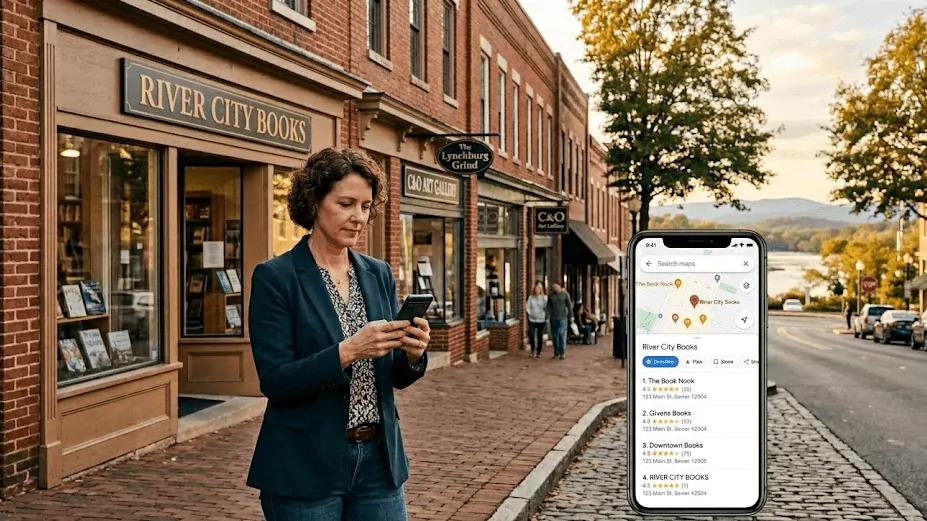
How Google Decides Who Shows Up — and Who Disappears
Spent a Saturday morning at Percival's Island watching two kayakers launch into the James, and I found myself thinking about something a landscaping contractor had told me the week before. He'd been in business for eleven years, had 43 Google reviews, and couldn't figure out why a two-year-old competitor kept appearing above him in Maps searches. He was doing everything right — and still invisible to the searchers who mattered most.
The Google Maps ranking for local business isn't determined by who has been in business longest or who has the nicest photos. It's determined by a specific set of signals that Google evaluates on a rolling basis — and if you're not actively working those signals, someone else is.
Google's Maps algorithm ranks local businesses based on three core factors: relevance, distance, and prominence. Relevance measures how well your business profile matches what someone searched for. Distance measures how close your business is to the searcher's location. Prominence measures how well-known and trusted your business appears to be across the web, factoring in reviews, citations, and your overall online presence. Businesses that consistently rank well are typically winning on all three axes — not just one.
In 2026, BrightLocal's 2026 Local Search Ranking Factors research confirms that GBP primary category remains the single strongest ranking lever in the local pack, with review signals and behavioral factors gaining ground. The algorithm is increasingly rewarding active, well-maintained listings over dormant ones with good historical performance.
The landscaping contractor's problem turned out to be category selection and review recency. Both were fixable in an afternoon — and the results showed within three weeks.
| Ranking Signal Category | What Google Evaluates | What You Can Improve |
|---|---|---|
| Relevance | Does your profile match the search query? | Primary category, services listed, description, website content alignment |
| Distance | How far are you from the searcher? | Address accuracy, service area settings, local phone number format |
| Prominence | How trusted and well-known is your business? | Review volume and recency, citation consistency, website authority, GBP activity |
| Behavioral Signals | Do searchers engage with your listing? | Photo quality, post frequency, Q&A responses, listing completeness |
| Website Signals | Does your site support your local authority? | GBP landing page optimization, service area content, page speed, NAP match |
Most of those signals are actively controllable. The businesses that consistently appear in Lynchburg's local pack are the ones doing the maintenance work — not just the setup.
Understanding which of those levers is currently weakest for your business determines where to focus first — and the answer looks different depending on whether you're invisible entirely, or visible but stuck in position four through eight.
The Proximity Trap and What Actually Moves Google Maps Rankings
The most common misconception I encounter is that proximity is everything — that if you're not physically closest to the searcher, you can't rank. It's not that simple. Proximity matters, but relevance and prominence can offset it significantly.
I've watched a Timberlake-based contractor consistently outrank a downtown competitor for searches originating from the Riverfront Park waterfront area — despite being geographically further from those searchers. The Timberlake business had more reviews, more specific service listings, and a website that Google could clearly connect to the GBP listing. The downtown competitor had proximity and not much else.
What factors determine Google Maps ranking for local businesses? According to the 2026 Local Search Ranking Factors research, the primary category remains the top influence, followed by review signals (volume, recency, response rate), behavioral engagement with the listing, and the quality of the website linked to the profile. Distance is real, but it's one variable in a multivariable equation — and it's the only one you can't easily improve.
Review recency is a signal most business owners don't think about. A business with 80 reviews from three years ago will often underperform against a competitor with 40 reviews from the past six months. Google's algorithm values current activity as a proxy for business health. A dormant review profile looks like a dormant business.
The GBP-to-website connection is also underestimated. When Google crawls your website and finds service descriptions, a local phone number, city references, and structured data that mirror your GBP, it builds more confidence in your listing. Disconnect between the two — different phone numbers, inconsistent service names, mismatched addresses — introduces noise that suppresses your visibility.
What keeps most businesses stuck isn't a single big problem. It's several small disconnects operating simultaneously, each one suppressing rankings a little, adding up to invisibility.
What's Actually Causing Businesses to Disappear From the Map Pack
Talked through a Maps ranking issue with a small engine repair shop last spring — located near Odd Fellows Road, family-owned for over a decade, solid reputation in the community. Their issue wasn't competition from a better business. It was a duplicate listing that had been created years earlier when someone tried to add them to Google before they claimed the profile themselves. The duplicate was absorbing some of their review equity and confusing Google about which listing was canonical.
Duplicate listings are one of the more quietly damaging issues in local search. Google discovers them through data aggregators and user-submitted edits, not always flagging them visibly. An unclaimed or duplicate listing often has stale information — an old address, a disconnected phone number — and Google sometimes surfaces it alongside or instead of the legitimate profile.
Why does my business show up on Google Maps but not in the top results? Appearing in Maps at all and ranking in the top three positions are very different things. The 3-pack is where the vast majority of clicks go. A listing that's technically present but ranked seventh or eighth sees dramatically less traffic than the top three. Improving your position from page-two visibility to the 3-pack requires the same signals that earn top placement — stronger reviews, more relevant category and service data, and a website that actively supports your local authority.
Citation consistency is another factor that slips. Every directory where your business name, address, and phone number appear differently — even minor variations like "St" versus "Street" — creates small amounts of conflicting data. Over time, enough conflicting signals tell Google that your listing may not be entirely reliable. Cleaning up citation inconsistencies doesn't produce dramatic ranking shifts overnight, but it removes friction that's been suppressing your visibility.
The businesses I've watched reclaim map visibility after disappearing usually had one or two specific problems, not a general weakness everywhere. The work is diagnosing which specific signal is underperforming, then addressing it directly. Understanding how to dominate Lynchburg's local 3-pack starts with knowing exactly what's currently working against you.
Frequently Asked Questions About Google Maps Ranking for Local Business
Why is my business not showing up on Google Maps?
The most common reasons are: your Google Business Profile isn't verified, your primary category doesn't match the searches you want to appear for, your listing has low review count or stale reviews, or a duplicate listing is diluting your profile's authority. In some cases, an address or phone number mismatch between your GBP and your website is creating enough conflicting data to suppress your visibility. Each of these is diagnosable and fixable.
How long does it take to improve your Google Maps ranking?
Simple fixes like correcting your primary category or resolving a duplicate listing can show ranking movement within one to three weeks. Improvements driven by review velocity or citation cleanup typically take four to eight weeks to reflect in your position. Building website authority and consistent GBP activity compounds over three to six months. There's no reliable shortcut — the algorithm rewards sustained, genuine signals over one-time interventions.
Do Google reviews help you rank higher on Google Maps?
Yes, reviews are among the most heavily weighted ranking signals for local pack placement. Volume, recency, response rate, and the content of the reviews all contribute. A consistent stream of new reviews — even a modest few per month — outperforms a large but static review count. Responding to every review, positive and negative, also signals engagement that Google interprets as an active, trustworthy listing.
How does my website affect my Google Maps ranking?
The URL linked in your GBP is a significant ranking variable. Google evaluates the landing page for relevance, local signals, and content quality. A page that explicitly mentions your services, includes your city, loads quickly on mobile, and uses structured data markup will support your map ranking better than a generic homepage. Businesses that think of their GBP and website as separate assets tend to underperform those who manage them as an integrated system.
What is the Google Maps 3-pack and how do I get into it?
The Google local 3-pack is the set of three business listings that appears in a box at the top of local search results, above organic website rankings. It's where the majority of clicks go for local queries, making it the highest-value real estate in local search. Getting into the 3-pack requires strong performance across relevance (category and service alignment), prominence (reviews, citations, website authority), and proximity relative to the searcher. It's achievable for most businesses with consistent optimization — but it takes time and ongoing maintenance to hold a position once earned.
Can I improve my Google Maps ranking without paying for ads?
Yes. Google Maps local pack rankings are organic — they're determined by the quality and relevance of your listing and website, not by advertising spend. Paid Google Local Services Ads can appear above the organic pack, but the organic 3-pack positions are earned through optimization. Most of the factors that influence your ranking — category selection, review generation, website alignment, citation consistency — require time and attention rather than advertising budget.
Why does my Google Maps ranking change depending on where someone searches from?
Google's proximity signal means your ranking shifts based on the searcher's physical location at the time of the query. A business might rank in the top three for someone searching from nearby, but fall to position six or seven for someone searching from across the city. This is why geo-grid rank tracking tools are more informative than single-location rank checks. Understanding how your ranking varies across your service area helps identify where your prominence signals need strengthening to offset the distance disadvantage in specific zones.
Where to Go If the Map Pack Feels Out of Reach
There's a version of local search where Lynchburg's map pack feels like a locked room. But most of the time, the door isn't locked — it's just that nobody ever gave the business a clear picture of where the gaps actually are.
I've seen service-area businesses make meaningful map ranking improvements in a matter of weeks once they knew which specific signals to address. The work isn't complicated. It requires consistency, honesty about where the current listing falls short, and a willingness to do the maintenance that most competitors are ignoring.
If you want a clear picture of what's keeping your business out of Lynchburg's local 3-pack, the team at Think Local Agency's local SEO services is built for exactly that conversation. They work with local businesses across the Hill City on the specific, unglamorous work that actually moves map rankings. Call 434-215-9139 and tell them where you're currently showing up — the diagnosis usually takes about fifteen minutes, and the answer is almost always more specific than "you need more reviews."

Jesse Griffiths, founder of Think Local Agency
Hey there — I’m Jesse. I’ve been helping small businesses grow their online presence for over 10 years, and I started Think Local Agency because I believe every business deserves honest, straightforward marketing that actually gets results. When we work together it’s just you and me — no account managers, no layers, no feeling like “just another client.” I still answer my own phone and reply to my own emails because your success matters to me personally.

Privacy & Policy
Last Updated: May 24, 2023
This Privacy Policy explains how Think Local Agency (hereafter “we”, “us”, “our”) collects, uses, shares, and protects your personal information when you use our website, thinklocalagency.com. Please read this policy carefully to understand our practices regarding your personal information and how we will treat it.
Information We Collect
When you visit our website, we may collect the following information:
- Personal Information: This may include your name, address, email address, phone number, and other personal information you voluntarily provide to us when you request a quote, schedule a service, or contact us.
- Non-Personal Information: We collect non-personal information such as your browser type, IP address, operating system, and the pages you visited on our site.
How We Use Your Information
We use the information we collect to:
- Provide, maintain, improve, and promote our services
- Communicate with you about your requests, orders, and questions
- Personalize your user experience on our website
- Analyze website usage for internal marketing and quality control purposes
Sharing Your Information
We do not sell or rent your personal information to third parties. We may share your information with service providers that assist us with our business operations, such as IT and customer service, under strict data protection requirements.
We may also disclose your personal information if required by law or in the event of a business transfer (e.g., sale, merger, or acquisition).
Cookies
Our website uses “cookies” to enhance your experience. Cookies are small files stored on your device that allow us to recognize you when you return to our site. You can choose to accept or decline cookies by modifying your browser settings.
Protecting Your Information
We implement a variety of security measures to maintain the safety of your personal information. These include encryption, secure server environments, and other current technologies. However, please note that no method of transmission over the internet is 100% secure.
Children’s Privacy
Our website is not intended for use by individuals under the age of 18. We do not knowingly collect personal information from children under 13. If we discover that a child under 13 has provided us with personal information, we will promptly delete it.
Changes to This Policy
We may periodically update this policy. If we make significant changes, we will notify you through our website or via email.
Contact Us
If you have any questions or concerns about our Privacy Policy, please contact us at 434-215-9139.
By using our site, you consent to our Privacy Policy. If you do not agree with any part of this Policy, please do not use our website.
Terms of Services
Terms Of Service
Last Updated: May 24, 2023
Welcome to Think Local Agency (hereinafter “we”, “us”, “our”). The following Terms of Service (the “Terms”) govern your access to and use of our website thinklocalagency.com (the “Website”) and any services provided (the “Services”).
By using our Website and Services, you agree to be bound by these Terms. If you do not agree to these Terms, please do not use our Website or Services.
1. Use of our Website
You are permitted to use our Website for your personal, non-commercial use, or legitimate business purposes, provided your activities are lawful and in accordance with these Terms. You are not permitted to use our Website for any illegal or harmful purpose, or in any manner that could interfere with the operation of our Website.
2. User Content
If you submit or upload any content on our Website, you agree not to upload any content that is offensive, defamatory, or illegal, or that infringes on the rights of others. We reserve the right to remove or modify any content that we believe violates these standards or any other provisions of these Terms.
3. Intellectual Property
All content and materials available on our Website are owned by us or our licensors, and are protected by copyright, trademark, and other intellectual property laws. You may not use, copy, modify, distribute, or create derivative works from any part of our Website without express consent from us.
4. Service Appointments and Cancellations
When you book a service appointment, you agree to provide truthful and accurate information. You also agree to promptly notify us of any changes to your appointment.
In case of cancellations, please inform us at least 24 hours before your scheduled appointment. We reserve the right to charge a cancellation fee for any no-shows or late cancellations.
5. Disclaimers and Limitations of Liability
Our Website and Services are provided “as is” without any guarantees or warranties, expressed or implied. We do not warrant that the operation of our Website will be uninterrupted, error-free, or completely secure.
To the maximum extent permitted by law, we will not be liable for any direct, indirect, punitive, or consequential damages that may result from the use or inability to use our Website or Services, even if we have been advised of the possibility of such damages.
6. Changes to these Terms
We may periodically update these Terms. Any changes will be posted on this page, and by continuing to use our Website, you agree to be bound by any modifications to these Terms.
7. Governing Law
These Terms are governed by the laws of Virginia, USA. Any dispute arising from these Terms shall be resolved exclusively in the courts of Lynchburg, Virginia.
8. Contact Us
If you have any questions or concerns about these Terms, please contact us at 434-215-9139.