
What I Keep Seeing Miss When Lynchburg Contractors Search for Their Own Business on Google
The Contractor Who Kept Losing Bids in Lynchburg — and Didn't Know Why
A roofing contractor I spoke with last fall had been working Graves Mill Road and the surrounding neighborhoods for eleven years. Good work, solid word-of-mouth, a truck with a clean wrap. But when his nephew searched "roofing contractor near me" from a Lynchburg address and showed him the results, the contractor's business wasn't anywhere on the first page. A company that had been open for two years — with a fraction of his reviews — was sitting in the number-one spot in the local pack.
That moment is more common than most contractors in this area realize. Local SEO for contractors in Lynchburg, VA isn't just about having a website — it's about whether Google can find, trust, and rank your business when someone in Campbell County or Forest pulls out their phone and types what they need.
The contractor I mentioned eventually figured out that his Google Business Profile had the wrong service area set, outdated categories, and zero posts in over a year. The two-year-old competitor had 47 recent reviews and photos uploaded every week. Google didn't need to think twice about which one looked like the active, trustworthy business.
If you've been operating in this market for years and still aren't showing up, the problem almost certainly isn't your quality of work. It's the signals you're sending — or not sending — to Google.
What Local SEO for Contractors Actually Means
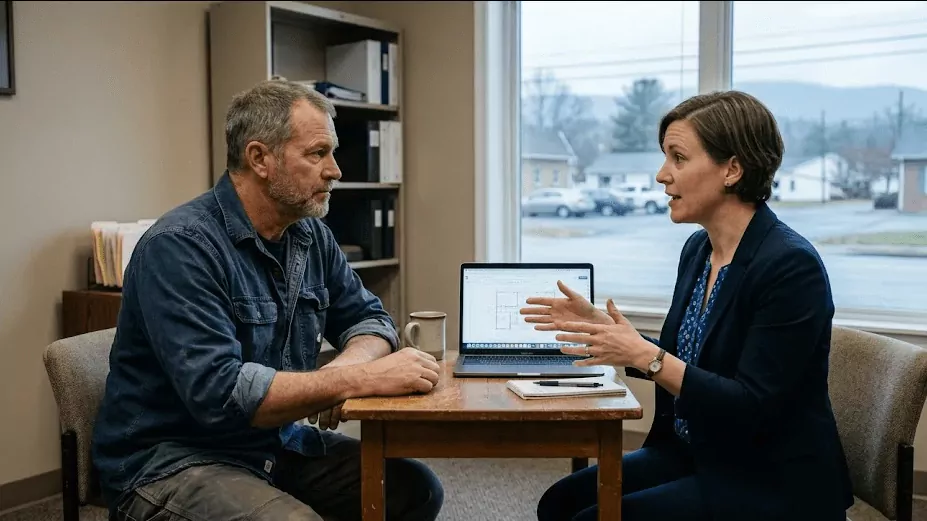
Pulled up a conversation I had at Nomad Coffee Co. recently — a general contractor sitting across from me with his laptop open, genuinely confused about why his business wasn't showing on Google Maps despite having a claimed profile. He'd heard the term "local SEO" thrown around but thought it meant keywords on a website. That's a piece of it, but not the whole picture.
Local SEO for contractors is the practice of optimizing every digital signal that tells Google your business is legitimate, active, and located where it claims to be. For service area businesses like HVAC companies, electricians, plumbers, and general contractors, those signals work differently than they do for a restaurant or retail shop with a fixed address.
Google's local ranking algorithm weighs three main factors: relevance (does your business match what the person searched?), distance (how close is your business to the searcher?), and prominence (how well-known and trusted does your business appear?). Contractors struggle most with prominence — because building it requires consistent, ongoing effort, not a one-time setup.
The direct answer: a contractor ranks in Google's local results by maintaining an optimized Google Business Profile with accurate categories, regular posts, and fresh photos, building consistent citations across directories, and generating a steady stream of verified customer reviews. All three of those systems need to be running simultaneously.
| Signal Type | Strong Signal | Weak or Missing Signal | Common Contractor Mistake |
|---|---|---|---|
| GBP Categories | Primary + 2–3 secondary categories match services offered | Single generic category (e.g. "Contractor") | Never revisiting categories after initial setup |
| Reviews | 10+ reviews, consistent monthly velocity, owner responses | 5 reviews from 3 years ago, no responses | Asking once at job end, then forgetting the system |
| Website Pages | Separate page per service with local keyword + city | One "Services" page listing everything in a paragraph | Single-page website with no service-specific content |
| Citations | Name, address, phone consistent across 40+ directories | Listed on only 3–4 sites, phone number varies | Using old address or P.O. box in some listings |
| GBP Activity | Weekly posts, current photos, updated hours | Profile claimed but untouched for 12+ months | Thinking "set it and forget it" after claiming |
The table above captures something I've seen repeated across dozens of contractor profiles in this area: it's rarely one catastrophic failure. It's the accumulation of weak signals across every category that buries a business in the rankings.
Most contractors reading this have probably done at least one of those things on the right side of that table — not out of laziness, but because nobody explained that these things are actively working against them in Google's eyes. But understanding the problem is only the first layer; the harder question is why Google treats service area businesses differently than businesses with a physical storefront.
Why the Local Pack Is Harder to Crack for Service Area Businesses
Sat with an electrician at Isabella's Italian Trattoria in Boonsboro a few months back — he was convinced his competitor had paid someone to suppress his listing. He hadn't. What was happening is something Whitespark's service area business guide documents clearly: contractors who hide their address on their GBP (as Google technically recommends for businesses that don't serve customers at a physical location) can lose ranking proximity advantage in the process.
Google's local algorithm anchors rankings around a physical location. A brick-and-mortar plumbing supply store on Fort Avenue gets a natural radius of relevance around that address. A plumber who works out of their home in Timberlake and correctly hides their address? Google falls back to the original verification address — which may be miles from where most of their customers actually are.
This is one of the most frustrating realities of local SEO for contractors in Lynchburg, VA. Following Google's own guidelines can put you at a structural disadvantage against competitors who are violating those guidelines by showing residential addresses. It's not fair, but it's the current playing field.
The workaround that most experienced local SEO practitioners recommend is building what's called a service area landing page strategy on your website — a dedicated page for each major area you serve (Lynchburg, Campbell County, Madison Heights, Forest) with genuinely unique content about your work in that area. These pages can rank in organic results even when your local pack presence is limited by the address issue.
Does having more Google reviews actually improve rankings? According to most current research from the local SEO industry, yes — both the quantity and recency of reviews are signals Google weighs in local prominence scoring. A contractor with 60 reviews and a 4.7 average, with responses to most of them, will almost always outrank an identical business with 8 reviews and no responses, assuming other factors are equal. The key word there is "recency" — a burst of 40 reviews three years ago helps less than 4–5 reviews per month, every month.
There's also a 2026 wrinkle that's worth knowing about: Google has been more aggressively filtering what it considers suspicious review patterns, which means contractors who tried to game the system with bulk reviews in 2024 are now seeing those reviews stripped from their profiles. Contractors who built their review count slowly and legitimately are the ones holding their ground right now.
Ranking in the local pack is partly about technical signals and partly about sustained behavior over time — and that difference matters when you're trying to figure out why your competitor pulled ahead.
The Website Problems That Keep Lynchburg Contractors Off Page One
The most common thing I see when I look at contractor websites in this market is the single-page problem. Everything crammed into one page: roofing, siding, gutters, decks, windows — all described in one or two paragraphs under a "Services" heading. From a user experience standpoint, it's functional. From a search standpoint, it's nearly invisible.
Google needs a distinct page to rank for a distinct search query. "Deck builder Lynchburg VA" and "gutter installation Lynchburg" are two separate searches with two separate intents. If both live on one page, Google has no way to rank your site for either one with any confidence. The fix is straightforward — create a dedicated page for each service, written specifically for that service, with local references and relevant content — but most contractors either don't know this or don't have time to execute it.
Beyond page structure, the other website issue that stalls contractor rankings is NAP consistency. NAP stands for Name, Address, and Phone — and it needs to appear identically everywhere your business is listed online. I've seen contractors whose GBP shows one phone number, their website footer shows another, and their HomeAdvisor listing shows a third. To Google, those three listings look like three potentially different businesses, and it downgrades trust accordingly.
The local SEO services that actually move the needle for contractors combine GBP optimization, citation cleanup, and service page development into a single coordinated effort. Doing just one of those in isolation rarely produces lasting results — which is why so many contractors try "doing SEO" once, see no movement, and give up on it entirely.
There's one more website factor that the local SEO industry paid more attention to in early 2026: page speed on mobile. Google's helpful content signals now include behavioral data — whether visitors stay on your page or immediately bounce back to search results. A slow-loading contractor website, especially on a mobile connection, sends a quiet negative signal that compounds over time. A contractor I know whose site took nine seconds to load on a phone saw meaningful improvement in local rankings within two months of fixing the issue — not because speed is a direct ranking factor in local, but because the bounce rate improvement fed into broader site quality signals.
The website issues are fixable, and most contractors can resolve the structural ones without a complete redesign — but knowing where to look first is the part that trips most people up.
Frequently Asked Questions About Local SEO for Contractors
Why don't contractors show up on Google Maps?
The most common reasons contractors don't appear on Google Maps are an incomplete or inactive Google Business Profile, an incorrect primary category, and an address issue common to service area businesses. Google ranks businesses based on relevance, distance, and prominence — contractors who haven't updated their profile in months and have few recent reviews typically fall outside the local pack, even in markets where competition isn't intense.
A second layer of the problem is the service area business structure itself. Contractors who hide their address on Google's recommendation can lose the proximity advantage that comes with a visible physical location, which means they need to compensate through stronger website content and higher review velocity to stay competitive.
How do I get my contracting business to rank higher on Google?
Start with your Google Business Profile: verify that your primary category matches your core service, add 2–3 secondary categories for other services you offer, upload at least 10 current photos, and post an update at least once per week. Then audit your citations — make sure your business name, address, and phone number appear identically on every directory where you're listed.
Once those fundamentals are in place, the highest-leverage ongoing activity is consistent review generation. Even 2–3 new reviews per month, sustained over six months, can shift a contractor's local pack position in a market like Lynchburg's.
What is local SEO for contractors?
Local SEO for contractors is the process of optimizing the digital signals Google uses to determine whether a service business appears when someone nearby searches for the type of work that contractor does. It includes Google Business Profile management, website structure, citation building across online directories, review generation, and service area page strategy. Unlike national SEO, local SEO is designed to compete within a specific geographic radius — typically the city and surrounding communities a contractor actually serves.
Does a service area business rank lower than a brick-and-mortar location?
In some situations, yes — service area businesses that hide their address can experience a narrower ranking radius than businesses with a visible physical address, because Google anchors local pack rankings around a confirmed location. This doesn't mean service area businesses can't rank well; it means they need to compensate with stronger off-profile signals like website service area pages, high review velocity, and consistent citations.
The practical implication for Lynchburg contractors is that building a website with dedicated pages for each neighborhood or county you serve — Lynchburg, Campbell County, Amherst, Madison Heights — can help you rank in organic results even when local pack positioning is constrained by the address visibility issue.
How important is a Google Business Profile for contractors?
It's arguably the single most important digital asset a contractor can maintain. Studies in the local SEO industry consistently show that the majority of local search clicks go to the businesses that appear in the Google Maps local pack — the three-result block that appears above organic website listings. A contractor without an optimized, active GBP is essentially invisible to anyone searching from a phone, which is where the overwhelming majority of "near me" and service-type searches originate.
Beyond visibility, the GBP is also where reviews live — and reviews are both a ranking signal and the first thing prospective customers look at before deciding whether to call. A profile with 40 reviews and a 4.8 rating communicates trust before the homeowner has read a single word of your website.
Do online reviews affect a contractor's Google ranking?
Yes. Review signals — including total count, recency, average rating, and whether the business owner responds — contribute to the prominence component of Google's local ranking algorithm. In competitive contractor categories like HVAC, roofing, and electrical, review velocity (how frequently new reviews are posted) is often the variable that separates businesses in positions one through three from those in positions four through ten.
The most effective approach is building a simple, repeatable system for asking every completed-job customer to leave a review — a follow-up text with a direct review link, sent within 24 hours of job completion. That consistency, sustained over months, builds the kind of review profile that Google consistently rewards with higher local pack placement.
If You've Been Invisible, You Don't Have to Stay That Way
The contractors doing well in Lynchburg's local search results right now aren't necessarily the most skilled or longest-tenured in the area. They're the ones who built a system — even a simple one — around their Google presence. That's a little uncomfortable to hear when you've been in business for a decade and watched someone newer climb past you, but it's also genuinely good news. Because systems can be built.
For more on how contractors in this market are approaching their digital presence, the post on dominating home service searches in Lynchburg covers some of the tactical specifics in more depth. And if you want to understand how your current profile stacks up against competitors in the local pack, that audit work is where most meaningful improvements start.
If you're a contractor in Lynchburg who's been watching this happen to your business and you're ready to stop being invisible on Google, Think Local Agency works specifically with local businesses in this market — you can reach the team directly at 434-215-9139, and the conversation starts with looking at exactly what Google sees when someone searches for what you do.

Jesse Griffiths, founder of Think Local Agency
Hey there — I’m Jesse. I’ve been helping small businesses grow their online presence for over 10 years, and I started Think Local Agency because I believe every business deserves honest, straightforward marketing that actually gets results. When we work together it’s just you and me — no account managers, no layers, no feeling like “just another client.” I still answer my own phone and reply to my own emails because your success matters to me personally.

Lynchburg, VA ~ 434-215-9139
Privacy & Policy
Last Updated: May 24, 2023
This Privacy Policy explains how Think Local Agency (hereafter “we”, “us”, “our”) collects, uses, shares, and protects your personal information when you use our website, thinklocalagency.com. Please read this policy carefully to understand our practices regarding your personal information and how we will treat it.
Information We Collect
When you visit our website, we may collect the following information:
- Personal Information: This may include your name, address, email address, phone number, and other personal information you voluntarily provide to us when you request a quote, schedule a service, or contact us.
- Non-Personal Information: We collect non-personal information such as your browser type, IP address, operating system, and the pages you visited on our site.
How We Use Your Information
We use the information we collect to:
- Provide, maintain, improve, and promote our services
- Communicate with you about your requests, orders, and questions
- Personalize your user experience on our website
- Analyze website usage for internal marketing and quality control purposes
Sharing Your Information
We do not sell or rent your personal information to third parties. We may share your information with service providers that assist us with our business operations, such as IT and customer service, under strict data protection requirements.
We may also disclose your personal information if required by law or in the event of a business transfer (e.g., sale, merger, or acquisition).
Cookies
Our website uses “cookies” to enhance your experience. Cookies are small files stored on your device that allow us to recognize you when you return to our site. You can choose to accept or decline cookies by modifying your browser settings.
Protecting Your Information
We implement a variety of security measures to maintain the safety of your personal information. These include encryption, secure server environments, and other current technologies. However, please note that no method of transmission over the internet is 100% secure.
Children’s Privacy
Our website is not intended for use by individuals under the age of 18. We do not knowingly collect personal information from children under 13. If we discover that a child under 13 has provided us with personal information, we will promptly delete it.
Changes to This Policy
We may periodically update this policy. If we make significant changes, we will notify you through our website or via email.
Contact Us
If you have any questions or concerns about our Privacy Policy, please contact us at 434-215-9139.
By using our site, you consent to our Privacy Policy. If you do not agree with any part of this Policy, please do not use our website.
Terms of Services
Terms Of Service
Last Updated: May 24, 2023
Welcome to Think Local Agency (hereinafter “we”, “us”, “our”). The following Terms of Service (the “Terms”) govern your access to and use of our website thinklocalagency.com (the “Website”) and any services provided (the “Services”).
By using our Website and Services, you agree to be bound by these Terms. If you do not agree to these Terms, please do not use our Website or Services.
1. Use of our Website
You are permitted to use our Website for your personal, non-commercial use, or legitimate business purposes, provided your activities are lawful and in accordance with these Terms. You are not permitted to use our Website for any illegal or harmful purpose, or in any manner that could interfere with the operation of our Website.
2. User Content
If you submit or upload any content on our Website, you agree not to upload any content that is offensive, defamatory, or illegal, or that infringes on the rights of others. We reserve the right to remove or modify any content that we believe violates these standards or any other provisions of these Terms.
3. Intellectual Property
All content and materials available on our Website are owned by us or our licensors, and are protected by copyright, trademark, and other intellectual property laws. You may not use, copy, modify, distribute, or create derivative works from any part of our Website without express consent from us.
4. Service Appointments and Cancellations
When you book a service appointment, you agree to provide truthful and accurate information. You also agree to promptly notify us of any changes to your appointment.
In case of cancellations, please inform us at least 24 hours before your scheduled appointment. We reserve the right to charge a cancellation fee for any no-shows or late cancellations.
5. Disclaimers and Limitations of Liability
Our Website and Services are provided “as is” without any guarantees or warranties, expressed or implied. We do not warrant that the operation of our Website will be uninterrupted, error-free, or completely secure.
To the maximum extent permitted by law, we will not be liable for any direct, indirect, punitive, or consequential damages that may result from the use or inability to use our Website or Services, even if we have been advised of the possibility of such damages.
6. Changes to these Terms
We may periodically update these Terms. Any changes will be posted on this page, and by continuing to use our Website, you agree to be bound by any modifications to these Terms.
7. Governing Law
These Terms are governed by the laws of Virginia, USA. Any dispute arising from these Terms shall be resolved exclusively in the courts of Lynchburg, Virginia.
8. Contact Us
If you have any questions or concerns about these Terms, please contact us at 434-215-9139.