
The SEO Timeline Lynchburg Business Owners Weren't Warned About
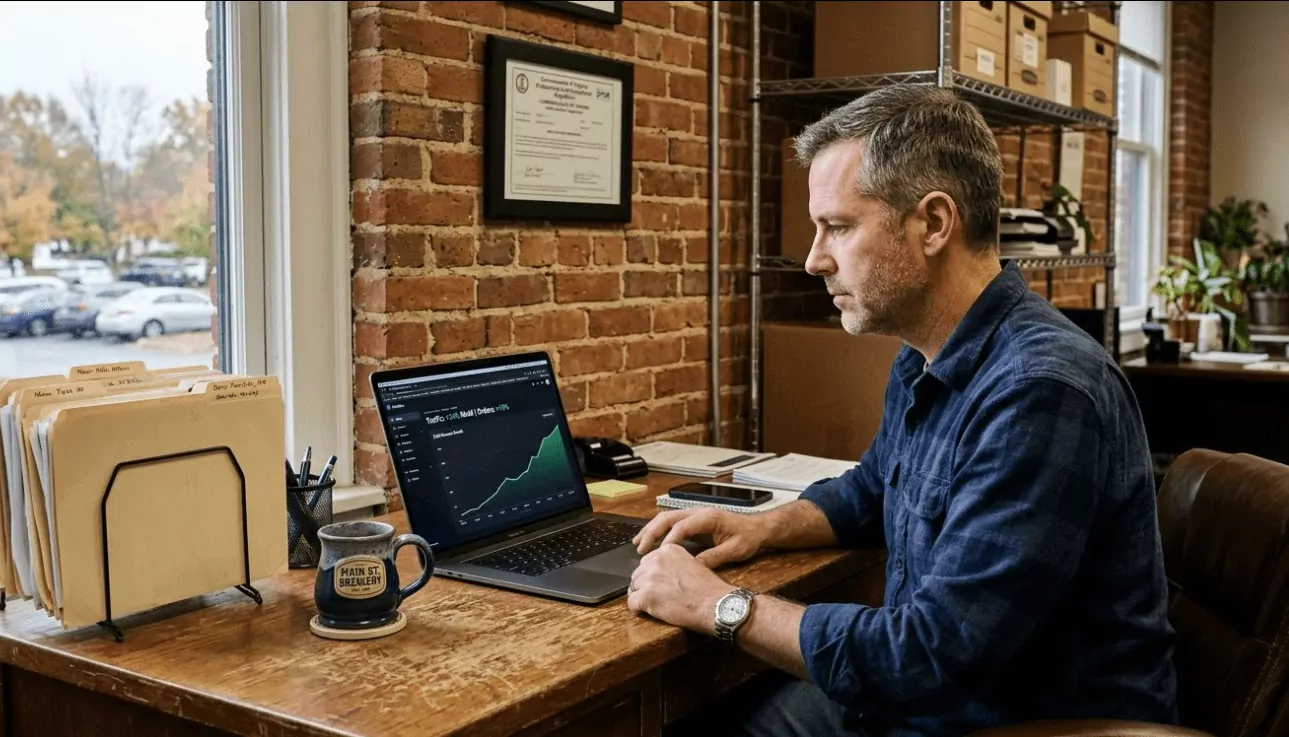
The contractor sitting two stools down from me at Mission House Coffee wasn't angry, exactly — more like he'd run out of a feeling to have about it. "Three months in and I can't find myself anywhere when I search," he said into his phone, voice low enough to blend into the espresso machine. He hung up and muttered something I've heard from a dozen business owners in Lynchburg since January: "Maybe this just doesn't work here." It does — but the seo timeline in Lynchburg Virginia works on a schedule most owners were never shown.
The First 90 Days: Why Your Lynchburg SEO Feels Like Silence
A flooring contractor near Timberlake Road called it "the longest nothing I've ever paid for." He was three weeks into a campaign, saw zero movement, and his profile looked identical to day one. His frustration made complete sense. What wasn't visible to him was everything happening underneath.
The first 90 days of a local SEO campaign are entirely foundational. A proper campaign starts with a technical audit — crawling the website for speed problems, mobile rendering issues, broken links, missing schema markup, and duplicate content. Google Business Profile gets rebuilt or corrected: categories verified, service areas mapped, business description rewritten around real local intent. Local citations — every mention of your business name, address, and phone number across the web — get audited and corrected, because inconsistent NAP data quietly suppresses local rankings in ways most owners never catch.
None of this work produces visible rankings. That's the part nobody warns you about.
Google doesn't reward a freshly optimized listing immediately. The algorithm needs time to re-crawl your site, process those changes, and accumulate enough updated signals before it shifts where you appear. On-page optimization runs in parallel: service pages rewritten around real local search intent, content drafted and scheduled, internal linking structured so Google understands the site's hierarchy.
One thing that genuinely surprises business owners is a brief ranking dip during this phase. When old, inconsistent citation data gets cleaned up, some inaccurate signals disappear before new accurate ones replace them — and rankings can wobble for two to four weeks. It passes. But owners who aren't told to expect it often stop the campaign at exactly the wrong moment.
By day 90, a well-run campaign should have a fully optimized GBP, a technically clean website, corrected citations, and a content calendar underway. Keyword movement may still be minimal — but the conditions for it are solidly in place.
The problem is that "conditions are in place" doesn't look like anything from the outside — and the difference between a campaign about to lift and one that's stalled often isn't visible until one specific signal changes.
Months 3–6: When the SEO Timeline in Lynchburg Virginia Finally Shows Itself
The seo timeline in Lynchburg Virginia follows a predictable arc once foundational work is complete. During months three through six, most local businesses begin seeing their first measurable signals: keyword positions climbing from page four to page two, Google Business Profile views increasing week over week, and occasionally a first organic phone call. These early signs are uneven — a ranking shifting from position 46 to position 19 doesn't feel like victory, but it reflects real momentum accumulating in the algorithm. This is what a healthy local SEO campaign looks like at the midpoint: not dramatic, but directional.
According to a survey of local search experts conducted by BrightLocal, significant local ranking improvements in competitive markets typically require three to six months of consistent, well-executed work. Lynchburg's market is moderately competitive across most home service trades, which puts the middle of that window as a realistic target for early movement.
Watching this pattern play out across the Hill City market, the shape of it repeats almost exactly. A residential painter working the Boonsboro corridor saw his first page-two organic rankings appear at month four. A heating contractor in Madison Heights appeared in the Google local 3-pack for the first time at week 14. Neither business was generating meaningful leads yet — but the direction was clear.
Content velocity starts mattering in this phase in a way it didn't during the first 90 days. Google's helpful content updates through 2025 reinforced what local SEO practitioners already knew: locally grounded, experience-driven content outperforms generic service page copy. A post about what to expect from a roof replacement in Lynchburg — written from real field experience — will outrank a national template stuffed with keywords.
Review velocity becomes a genuine competitive signal here too. The local 3-pack algorithm weighs recency alongside volume. A business with 40 reviews that hasn't received one in four months is losing ground to a competitor with 20 reviews arriving at two per week. This window is when a consistent, compliant review-request process starts creating real distance from competitors.
Here's how the overall SEO timeline typically breaks down by phase — and why the gap between what owners feel and what's actually happening can be so disorienting:
| Phase | Primary Work | What Owners Typically Feel | What's Actually Happening |
|---|---|---|---|
| Month 1–2 | Technical audit, GBP rebuild, citation cleanup | Nothing visible | Google re-crawling updated signals |
| Month 3–4 | On-page content, keyword targeting, internal linking | Small ranking shifts | Algorithm indexing new local signals |
| Month 5–6 | Review building, link acquisition, content publishing | Occasional ranking jumps | Trust signals accumulating, early 3-pack movement |
| Month 7–9 | Content expansion, authority building, GBP posts | Noticeable leads beginning | Compounding begins, consistent map visibility |
| Month 10–12 | Monthly optimization, reporting, content consistency | Steady organic calls | Algorithm trust established, rankings stabilizing |
Months three through six reveal whether the foundation was built correctly — but what the campaign actually produces only becomes visible in the window that follows, and it tends to arrive faster than most business owners expect.
Month 6 Through Month 12 — Where Phones Actually Start Ringing
Last fall, finishing an early walk along Ivy Creek before the fog cleared, I had a rank tracking report open on my phone for an HVAC company I'd been following for months. Month seven. Their 3-Pack appearances were up 34% from the prior month. Their organic call volume had nearly doubled week over week — still a modest absolute number, about six calls, but it was the beginning of something that compounds differently than any other marketing channel.
The six-to-twelve-month window is where the work from the first half of the year starts paying out. Rankings that moved from page four to page two in months three through six now push onto page one. Businesses that earned early 3-pack appearances begin showing up more consistently across a wider radius. The review velocity work generates social proof that converts visitors into callers. This is the phase where local visibility strategies stop feeling abstract and start producing actual pipeline.
The difference between businesses that break through in this window and those that stall usually comes down to two things. Content consistency is the first — a business that published four quality local pages in months one through six and then stopped loses ground to a competitor publishing one or two per month without fail. Ongoing GBP activity is the second: regular posts, Q&A management, and fresh photos tell Google the listing is actively managed, not dormant.
For most home service trades in the Lynchburg area, this is also the window where Google's AI-generated summaries begin pulling from local business content. Posts that answered specific local questions with genuine experience start appearing in AI Overviews and featured snippets. That kind of visibility doesn't appear in a traditional rankings report — but it drives calls.
Businesses that complete a full twelve months often describe year two as the thing that made the investment make sense. Their rankings stabilize. Their review profile builds naturally. Their content library generates traffic on its own. For a more detailed breakdown of how to track each campaign milestone as it unfolds, the SEO timeframe guide on this site covers the measurement side in depth.
Even when the timeline goes exactly as expected, certain questions keep surfacing — and several of them carry assumptions that don't quite hold up once you look at how the local algorithm actually works in 2026.
Frequently Asked Questions About Local SEO Timelines in Lynchburg
How long does SEO take to work for a local business in Lynchburg?
Most Lynchburg businesses begin seeing measurable keyword movement between months three and four of a well-executed campaign. Meaningful lead generation — consistent organic phone calls — typically begins between months six and nine, depending on how competitive the service category is locally.
Businesses starting with no existing website or Google Business Profile tend to take longer than those with an established digital footprint. The investment compounds over time, meaning the ROI at month twelve typically far exceeds what the same campaign produced at month three.
What should I expect in the first 3 months of local SEO?
The first three months are almost entirely foundational — technical cleanup, GBP optimization, citation correction, and content planning. You may see little to no visible ranking movement, and rankings may dip briefly before recovering. That's a normal and expected part of the process.
What you should expect are clear deliverables: an optimized GBP, corrected citation data, a cleaner and faster website, and a content strategy in motion. If you're three months in and none of those things exist, something has gone wrong in the campaign execution.
How long does it take to rank in the Google local 3-pack in Lynchburg?
Local 3-pack appearances in Lynchburg typically begin showing up for some keywords between months four and six, with more consistent map pack visibility arriving between months seven and ten. The timeline varies by category — less competitive trades can see movement sooner than more saturated markets like HVAC or plumbing.
Review velocity, GBP completeness, and local citation accuracy are the three factors that most reliably accelerate 3-pack ranking in this market. A business with consistent incoming reviews and a fully optimized profile usually outperforms one with stronger website content but weaker profile signals.
What happens if I stop SEO after 6 months?
Stopping at month six typically produces gradual ranking decline over the following three to six months. Rankings earned through consistent work don't disappear overnight, but without ongoing signals — new content, continued review velocity, updated GBP posts — the algorithm begins favoring more active competitors.
In most cases, recovering rankings after stopping requires more sustained effort than maintaining them would have. Six months is precisely when compounding begins, which means stopping early means walking away from the highest-return period of the entire investment.
How do I know if my SEO is working?
The most reliable early indicators are GBP views, website sessions from organic search, and keyword ranking movement — these appear in Google Search Console and GBP Insights before phone calls do, typically by months three to four.
Ranking position alone is a misleading metric. A business can rank on page one for a term nobody searches and still generate zero calls. The numbers that actually matter are phone calls, direction requests, and form submissions traced back to organic search — not rankings in isolation.
Why is my Lynchburg business not ranking on Google yet?
The most common reasons Lynchburg businesses struggle to rank despite ongoing SEO effort are inconsistent citation data, an incomplete or under-optimized Google Business Profile, and a lack of locally relevant content on the website. A business with 80 national directory listings all showing slightly different addresses will suppress its own rankings regardless of how much other work is done.
Review recency is another frequently overlooked factor. Google's local ranking algorithm in 2026 weighs recency more heavily than total review count. A business that earned 50 reviews two years ago with none since is at a meaningful disadvantage against a competitor with 20 reviews and two new ones this month.
Is local SEO worth the investment for a small business in Lynchburg, VA?
For most home service trades — plumbing, HVAC, roofing, electrical, landscaping — local SEO in Lynchburg is typically one of the highest-ROI marketing channels available over a 12-to-24-month window. Unlike paid advertising, which stops producing results the moment the budget stops, SEO builds equity that continues generating leads without proportional spending increases.
The caveat is patience. Businesses that treat SEO as a three-month trial rarely see the returns that make it worthwhile. The compounding effect that makes local SEO so valuable in year two simply doesn't exist if the campaign ends at month five.
Year One Is the Foundation — Year Two Is Where the Business Changes
There's a particular kind of Wednesday in Lynchburg — the weekday lunch crowd thinning along Main Street downtown, the parking spots slowly opening back up — where I find myself running through year-over-year data for businesses I've been watching in this market. The ones that completed a full twelve months look dramatically different on paper than they did at month three. More calls. More visibility across a wider map radius. A review profile that builds trust before a potential customer even clicks through.
The businesses that stopped at month five or six usually can't articulate what they got out of it, because the compounding hadn't started yet. That's the quiet frustration of short SEO campaigns — they often end just before the return materializes.
Year two is a different experience entirely. Rankings that took six months to reach page one stay there with less active effort. Content published in year one starts generating passive traffic. New pages rank faster because the domain has accumulated real local authority. The work shifts from building trust to extending it.
None of this happens automatically. It requires a clear plan from the start, the patience to see the full timeline through, and an honest understanding of what each phase actually produces — not what it looks like from the outside.
If you're in month three wondering whether anything is working, the answer is almost certainly yes — you just can't see it yet. If you're at month eight and the phone still isn't ringing, the execution deserves a closer look. Either way, the most useful thing you can do is talk to someone who knows this specific market. Think Local Agency is based in Lynchburg and works with home service businesses throughout the Hill City and surrounding counties — call us at 434-215-9139 and we'll give you an honest read on where your campaign stands and what the next quarter should actually look like.

Privacy & Policy
Last Updated: May 24, 2023
This Privacy Policy explains how Think Local Agency (hereafter “we”, “us”, “our”) collects, uses, shares, and protects your personal information when you use our website, thinklocalagency.com. Please read this policy carefully to understand our practices regarding your personal information and how we will treat it.
Information We Collect
When you visit our website, we may collect the following information:
- Personal Information: This may include your name, address, email address, phone number, and other personal information you voluntarily provide to us when you request a quote, schedule a service, or contact us.
- Non-Personal Information: We collect non-personal information such as your browser type, IP address, operating system, and the pages you visited on our site.
How We Use Your Information
We use the information we collect to:
- Provide, maintain, improve, and promote our services
- Communicate with you about your requests, orders, and questions
- Personalize your user experience on our website
- Analyze website usage for internal marketing and quality control purposes
Sharing Your Information
We do not sell or rent your personal information to third parties. We may share your information with service providers that assist us with our business operations, such as IT and customer service, under strict data protection requirements.
We may also disclose your personal information if required by law or in the event of a business transfer (e.g., sale, merger, or acquisition).
Cookies
Our website uses “cookies” to enhance your experience. Cookies are small files stored on your device that allow us to recognize you when you return to our site. You can choose to accept or decline cookies by modifying your browser settings.
Protecting Your Information
We implement a variety of security measures to maintain the safety of your personal information. These include encryption, secure server environments, and other current technologies. However, please note that no method of transmission over the internet is 100% secure.
Children’s Privacy
Our website is not intended for use by individuals under the age of 18. We do not knowingly collect personal information from children under 13. If we discover that a child under 13 has provided us with personal information, we will promptly delete it.
Changes to This Policy
We may periodically update this policy. If we make significant changes, we will notify you through our website or via email.
Contact Us
If you have any questions or concerns about our Privacy Policy, please contact us at 434-215-9139.
By using our site, you consent to our Privacy Policy. If you do not agree with any part of this Policy, please do not use our website.
Terms of Services
Terms Of Service
Last Updated: May 24, 2023
Welcome to Think Local Agency (hereinafter “we”, “us”, “our”). The following Terms of Service (the “Terms”) govern your access to and use of our website thinklocalagency.com (the “Website”) and any services provided (the “Services”).
By using our Website and Services, you agree to be bound by these Terms. If you do not agree to these Terms, please do not use our Website or Services.
1. Use of our Website
You are permitted to use our Website for your personal, non-commercial use, or legitimate business purposes, provided your activities are lawful and in accordance with these Terms. You are not permitted to use our Website for any illegal or harmful purpose, or in any manner that could interfere with the operation of our Website.
2. User Content
If you submit or upload any content on our Website, you agree not to upload any content that is offensive, defamatory, or illegal, or that infringes on the rights of others. We reserve the right to remove or modify any content that we believe violates these standards or any other provisions of these Terms.
3. Intellectual Property
All content and materials available on our Website are owned by us or our licensors, and are protected by copyright, trademark, and other intellectual property laws. You may not use, copy, modify, distribute, or create derivative works from any part of our Website without express consent from us.
4. Service Appointments and Cancellations
When you book a service appointment, you agree to provide truthful and accurate information. You also agree to promptly notify us of any changes to your appointment.
In case of cancellations, please inform us at least 24 hours before your scheduled appointment. We reserve the right to charge a cancellation fee for any no-shows or late cancellations.
5. Disclaimers and Limitations of Liability
Our Website and Services are provided “as is” without any guarantees or warranties, expressed or implied. We do not warrant that the operation of our Website will be uninterrupted, error-free, or completely secure.
To the maximum extent permitted by law, we will not be liable for any direct, indirect, punitive, or consequential damages that may result from the use or inability to use our Website or Services, even if we have been advised of the possibility of such damages.
6. Changes to these Terms
We may periodically update these Terms. Any changes will be posted on this page, and by continuing to use our Website, you agree to be bound by any modifications to these Terms.
7. Governing Law
These Terms are governed by the laws of Virginia, USA. Any dispute arising from these Terms shall be resolved exclusively in the courts of Lynchburg, Virginia.
8. Contact Us
If you have any questions or concerns about these Terms, please contact us at 434-215-9139.